
You may be concerned about the safety risks associated with 12V LFP battery—specifically, misstated capacity or BMS failure. If you are seeking a reliable method to identify truly high-quality LFP modules, mastering the complete testing protocol serves as an effective shortcut. Today, Hongyitai Technology is unveiling its comprehensive process and standards—spanning everything from individual cell matching to the final full inspection and shipment of 12V battery packs—to help you avoid costly post-sales risks.
Table of Contents
ToggleProfessional Tools for 12V LiFePO4 Battery Testing
To ensure the safety and quality of our 12V Lithium Iron Phosphate (LiFePO4) battery packs, a standard multimeter is far from sufficient. We utilize industrial-grade inspection equipment and tools to implement rigorous Quality Control (QC) checks at every stage of the production process, ensuring that the parameters and performance of both the individual cells and the complete 12V battery packs meet the IEC62133 standard. Listed below are the instruments we employ for our 12V quality inspection:
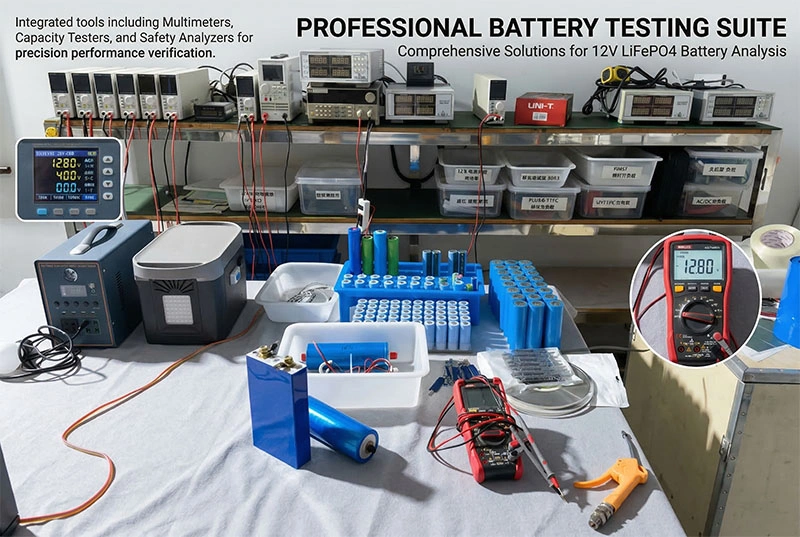
1. Multimeter. Used for the initial Open Circuit Voltage (OCV) inspection of Lithium Iron Phosphate (LiFePO4) cells; the standard voltage range is 3.20–3.30V.
2. Battery Capacity Grading Cabinet. By performing a complete charge-discharge cycle at a 0.5C current—repeated for three cycles—this device yields a precise measurement of the battery’s capacity, verifying whether the actual Amp-hour (Ah) capacity aligns with the specifications outlined in the datasheet.
3. Comprehensive Battery Tester. This specialized device is designed to simulate real-world load conditions, verifying the response times of the Battery Management System (BMS) regarding over-current, over-voltage, and short-circuit protection.
4. AC Internal Resistance Tester. Utilizing a simulated 1 kHz connection method, this instrument screens out cells exhibiting high internal resistance; for qualified 3.2V LiFePO4 batteries, the acceptable internal resistance range is 0.5–2.5 mΩ.
5. Shock and Mechanical Vibration Test Stand. This equipment simulates your actual operating environment (specifically impacts and vibrations), ensuring that the busbars and laser-welded joints within the entire battery pack remain securely attached.
3.2V LiFePo4 Cell Grading & Sorting
The consistency of individual 3.2V lithium iron phosphate (LiFePO4) cells is the key to a long service life. The overall performance of a 12V LiFePO4 battery pack is determined by its weakest cell; therefore, we insist on using cells from the same brand and production batch, and subject them to rigorous testing, including the following procedures:

1. Capacity Matching: We not only require Grade A cells but also subject them to a 100% charge-discharge test to ensure that capacity deviation is controlled within ±1%.
2. Internal Resistance Testing: Utilizing AC internal resistance testers, we strictly screen out any individual cells exhibiting an internal resistance deviation exceeding 2 mΩ.
3. Voltage Testing: All cells awaiting assembly are allowed to rest for 15 days within a controlled, constant-temperature environment to assess their self-discharge rate (K-value); cells exhibiting an excessive self-discharge rate are subsequently rejected.
Prior to assembly, if cells are not precisely matched into groups, any subsequent attempts to compensate for these discrepancies—even through the application of expensive balancing technologies—will prove to be of negligible effectiveness.
12V BMS Functional Integrity Test
If the battery cells constitute the heart of a 12V LiFePO4 battery pack, then the BMS serves as its brain; consequently, our IQC department conducts precise and rigorous testing on it, in accordance with the GB/T 34131-2023 standard.

1. Overcharge and Over-discharge Testing: We simulate charging at an overvoltage (15V) and force a discharge down to 10V to verify whether the protection board can promptly interrupt the circuit.
2. Short-Circuit Protection Testing: We manually trigger a simulated short circuit to observe whether the BMS can react within microseconds (μs); failure to do so could result in damage to internal components.
3. High and Low-Temperature Simulation: 0°C and 65°C serve as critical temperature thresholds; we verify whether the BMS can decisively disconnect the circuit should the temperature exceed these maximum limits.
4. Overcurrent Protection Testing: We subject the protection board to a current equal to twice its rated capacity to observe the response time required for it to disconnect the circuit.
Battery Capacity Verification & Discharge Curve

Taking a 12.8V 100Ah battery as an example, it is considered qualified only if it delivers a capacity of no less than 98Ah. Our factory strictly prohibits the mislabeling of capacity; therefore, battery capacity grading is an indispensable step in our process.
We utilize specialized grading cabinets to verify the batteries by subjecting them to a discharge test at a 0.5C current. By monitoring the actual amount of charge released, we are able to generate a true discharge curve. As is clearly evident from the data, there is an exceptionally long, stable voltage plateau within the 12.8V to 13.2V range, with the battery reaching its discharge cutoff at 10V.
12V LiFePo4 Battery Thermal Stability Simulation
12V lithium iron phosphate batteries are frequently used in extreme environments; therefore, thermal stability simulation testing is crucial.

1. High-Temperature Test: We place the entire battery pack in a constant-temperature chamber at 65°C to conduct charge-discharge testing, verifying that the weld points, wire gauges, and discharge capacity meet the required standards.
2. Low-Temperature Test: We verify whether the BMS can promptly disconnect the circuit at 0°C, and whether the entire battery pack can maintain a discharge capacity of greater than 70% at -20°C.
3. Thermal Shock Test: We subject the battery to rapid temperature transitions—moving it from an extremely low-temperature environment (-40°C) to an extremely high-temperature environment (55°C) within a 30-minute interval—for a total of five cycles. This test verifies that the battery remains in good physical condition and retains a discharge capacity of ≥85%.
Vibration & Mechanical Impact Test for Rugged Applications
To ensure that the 12V lithium battery module remains safe even on the “roughest roads or at sea,” we conduct the following simulation tests:

1. 3-axis Random Vibration Test: The battery is secured to a high-frequency vibration table and subjected to random vibration frequencies ranging from 10 Hz to 500 Hz. Upon completion, the unit is inspected to ensure that no screws have loosened and that the BMS wiring harness connectors have not become dislodged.
2. Mechanical Shock Simulation: This test simulates a battery drop or accidental impact (max. 50G/11ms). Following the test, the battery casing must remain intact without cracking, and the unit must continue to function normally.
3 Days High-Temperature Aging Test

Upon the assembly of the 12V lithium battery packs, we subject them to an aging test within a constant-temperature chamber maintained at 45°C to screen out any batteries prone to early-stage failure. Following this aging process, we conduct a precise re-measurement of the voltage. Experience has taught us that genuine quality defects often only begin to manifest after the aging phase; consequently, we are able to identify and eliminate defective batteries right at the factory, ensuring that no substandard products ever reach our clients.
Final Quality Audit (FQA) & Shipping Standards

This constitutes the final inspection stage: OQC. We conduct a comprehensive static re-verification of all performance parameters: voltage, internal resistance, dimensions, appearance, capacity, wire gauge, and labeling.
Furthermore, to ensure compliance with UN38.3 air and sea transport regulations, we affix Class 9 Dangerous Goods labels to every carton, thereby facilitating the smooth and successful delivery of your batteries. Find our quality 12V lifepo4 battery pack product here.
FAQs for 12.8V LFP battery
It is 12.8V.
Our factory standard: The static voltage difference must be less than 20 mV (0.02 V).
This is not recommended, as it requires re-matching the impedance and capacitance, as well as processes such as re-soldering. It is best to seek assistance from the supplier.
Yes, but the capacity for balance is limited.