
When assembling batteries for RVs, solar systems, or marine applications, you need to consider series and parallel connections to achieve the desired battery pack configuration. Proper battery configuration ensures long-term, efficient system operation; otherwise, potential problems such as voltage drops and overheating may occur.
Today, we’ll delve into the connection principles of series vs parallel batteries. More importantly, we’ll discuss the voltage limitations and wiring requirements of the Battery Management System (BMS) to ensure safe battery operation.
Table of Contents
ToggleThe Fundamental Difference: Voltage vs. Capacity
In simple terms, connecting batteries in series increases voltage, while connecting them in parallel increases capacity. We can think of batteries as water tanks, voltage as water pressure—higher pressure means stronger thrust, enabling more powerful devices. Capacity is like the volume of water: the larger the volume, the longer the supply time.
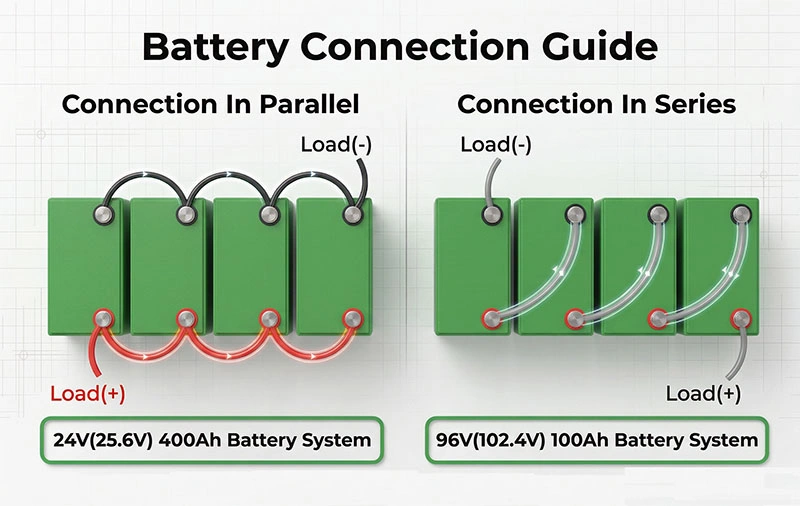
Series connection: Connect the positive terminal of the first battery to the negative terminal of the second battery. Two 12V 100Ah batteries connected in series result in a 24V 100Ah battery, easily providing power for 2000W while reducing wiring heat and energy loss.
Battery connection: Positive to positive, negative to negative. Two 12V 100Ah batteries connected in parallel result in a 12V 200Ah battery, extending the operating time of your equipment (RV lighting, refrigerator) in an existing 12V system.
You can click here to read more about how to connect 12V, 24V, 36V, and 48V batteries in series.
Connecting Batteries in Series: Boosting Your System Voltage
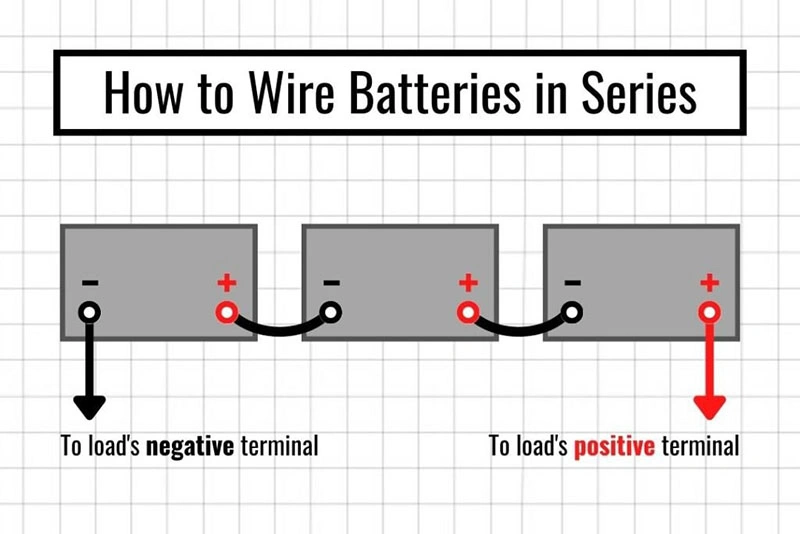
Series connection is the standard method to increase the total voltage of a battery pack. For driving high-power inverters (>3000W), series connection is a superior choice compared to parallel connection.
The core of series connection lies in “positive and negative terminals being connected.” Current flows through each battery, achieving a linear superposition of voltages while maintaining constant capacity. Vtotal = V1 + V2 + … + Vn. Taking a 12V battery pack as an example, series connection is the optimal choice to meet the needs of a 24V inverter or 48V off-grid solar power.
According to Ohm’s Law: P = I² * R, for the same output power, the higher the voltage, the lower the current. When the current decreases to half, the heat loss in the line decreases to one-quarter of its original value. Therefore, because the current is lower, you can choose a smaller diameter, shorter cable gauge.
Connecting Batteries in Parallel: Increasing Your Capacity

If you don’t want to change the overall battery voltage, parallel connection can increase capacity and extend your device’s runtime.
The core of parallel connection is “positives connected to positives, negatives connected to negatives.” The positive terminal of the total system is connected to the first battery, and the negative terminal is connected to the last battery, thus achieving linear capacity addition while maintaining a constant voltage. Ahtotal = Ah1 + Ah2 + … + Ahn.
Beginners please note: In a parallel battery system, the total current equals the sum of the currents of all batteries. If your load requires 200A of current, although each battery only carries 100A, the total output bus must withstand the full 200A. Therefore, you need to select matching AWG standard cables.
How to Connect Batteries in Series and Parallel Combination
The most common approach is to combine multiple batteries in series and parallel, used in large RVs, home energy storage centers, or industrial-grade backup power supplies.
Battery combination logic: Series first, then parallel. First, connect the batteries in series to form a battery module with the target voltage. For example, if you have two 12V 100Ah lithium iron phosphate batteries, you can first connect them in series to get a 24V 100Ah battery, and then connect two more in parallel to get a 24V 200Ah battery.
The series unit serves as the basic module to ensure voltage consistency. After connecting to a BMS, voltage, capacity, and internal resistance can be better monitored, allowing the battery to operate for a longer period.
Critical Safety Rules You Must Follow
Whether you connect batteries in series or parallel, the lifespan and safety of your battery pack depend on the following critical bottom lines:
**Never mix batteries.** This is the most common and fatal mistake. All batteries must be of the same brand, capacity, voltage, chemistry, and from the same batch.
**The BMS protection board has a maximum series limit before shipping. You need to confirm this with your supplier to avoid issues with series compatibility, which could damage the MOSFETs and cause permanent battery pack failure.
**Current and Heat:** The current doubles when connected in parallel, so thicker AWG cables must be used. The wires connecting each battery must be of exactly the same length to avoid uneven current distribution caused by slight differences in resistance.
**Equalize before assembling.** Charge all batteries individually to a specific voltage before combining them in series or parallel.
Which Configuration is Right for You
You can make the right decision based on the following 3 core dimensions:
1. Choose based on power requirements. If you need to run high-power appliances above 2000W, we recommend series connection to reduce current, resulting in lower system operating temperatures, greater safety, and higher efficiency. If you only need to run low-power appliances below 1000W, we recommend parallel connection, eliminating the need to purchase an expensive step-down converter.
2. Choose based on installation space and wiring. If space is limited, we recommend series connection because the lower current allows you to use thinner, more flexible cables.
3. Choose based on system reliability. If you require uninterrupted power backup, we recommend parallel connection, ensuring continued operation even if one battery pack fails. If you prioritize cost-effectiveness, we recommend series connection.
Conclusion
Series connection is essential for achieving high-efficiency, high-power systems, allowing for lower current draw and cooler operation; while parallel connection is ideal for achieving extended battery life and maintaining a simple 12V system. Of course, you can also view our 12V and 24V battery products with details.
FAQs for series and parallel in battery
No. Different brands of batteries have different chemical compositions, internal resistance, and discharge curves. To ensure system stability, please be sure to use batteries of the same brand, model, and batch.
No. Parallel connection only changes the capacity, not the voltage. However, with the overall battery capacity increased, the original charger may need to take longer to charge.
The entire battery pack will fail. In a series circuit, current must flow through each individual battery, causing the current in the entire circuit to drop sharply or be completely interrupted.