
As a brand owner or manufacturer, you’re undoubtedly terrified of your lithium polymer battery swelling, potentially disrupting your devices or even endangering consumer safety. Hongyitai, with over 10 years of experience manufacturing lithium polymer batteries, will analyze the four key factors that cause battery bulging and guide you on how to prevent it, enabling you to minimize the risk by addressing the root causes and implementing effective management measures.
Table of Contents
ToggleHigh-Temperature Exposure (Above 100°C)
The ideal operating temperature range for polymer batteries is -20°C to 60°C, but reality is different. During summer (June to August), when lithium batteries are shipped by sea, the battery temperature inside the container can quickly rise to 70-80°C, or even 100°C. Similarly, when drones operate at high power, the internal resistance heat generated by high-current discharge can cause a sharp increase in cell temperature.
In these high-temperature environments, lithium batteries are highly susceptible to thermal runaway. The internal organic solvent (ethylene carbonate) begins to decompose thermally, releasing CO2 and CO. This gas pressure directly causes noticeable bulging on the battery’s exterior.
Deep Discharge Due to Long-term Inactivity
Batteries stored in warehouses for extended periods are most prone to bulging. Polymer batteries have an inherent self-discharge characteristic; even when not connected to a load, internal chemical reactions continuously consume energy. When the voltage drops to 3V, the copper foil at the negative electrode undergoes electrochemical dissolution, producing copper ions. Once these ions accumulate, micro-short circuits can easily occur. During subsequent charging, the electrolyte reacts with the damaged electrode materials, producing gases such as H2.
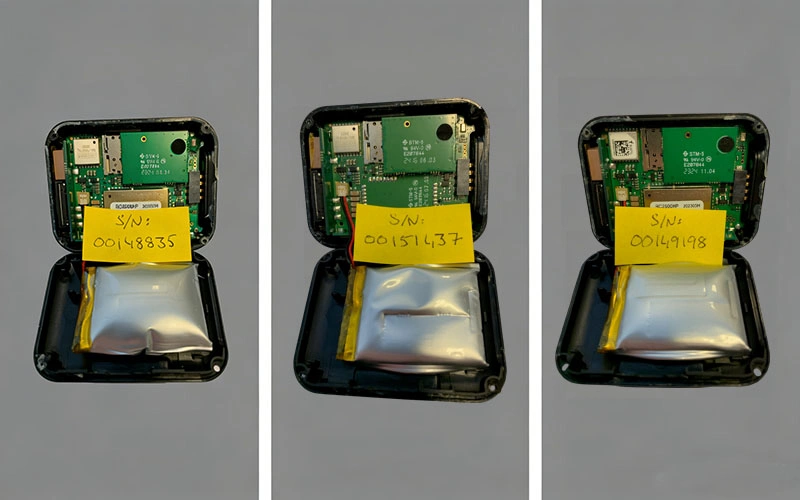
For example, one of our customers suddenly reported that 3 polymer batteries had bulged. From the photos, the batteries appeared clean and free of stains. The voltage across the positive and negative terminals was 0V. Upon receiving the returned batteries, we examined them under a microscope and found no punctures or other damage. Our engineers tested the batteries in a charge/discharge cabinet, and they showed normal operation. This is a typical case of bulging caused by over-discharge.
Our recommendation is: batteries stored for long periods should be kept between 3.8V and 3.85V and charged every 3-6 months. Given the current low market demand, we advise all customers to deliver batteries in batches to avoid storing large quantities in your warehouse.
Overcharging in Batteries Without PCM/BMS
Some factories, in pursuit of extremely low procurement costs, opt for bare battery cells without protection circuits. However, this practice is often the leading cause of widespread battery bulging and even fires.

When lithium batteries are continuously charged without protection circuitry, once the voltage exceeds the safe limit of 4.2V, their internal chemical balance is completely disrupted. At this point, excess lithium ions cannot properly embed into the negative electrode and instead deposit metallic lithium on the surface. These hard lithium dendrites act like sharp spikes, penetrating the separator and inducing internal micro-short circuits.
The threat of non-standard chargers: Third-party non-standard chargers used by end users often have unstable output voltages. Battery cells lacking PCM protection are completely defenseless against voltage surges.
Imbalance in multiple cells: Taking a 3S 11.1V lithium battery as an example, without a BMS (Battery Management System) with balancing capabilities, one cell may already be overcharged, while the charger continues to output a large current because it detects that the total voltage is below standard, causing the cell to expand rapidly.
Our professional recommendation: Dual protection mechanism, specifically as follows:
- Multi-dimensional monitoring: In addition to basic overcharge/over-discharge current protection, add an NTC (Thermistor) for real-time temperature monitoring.
- High-Precision IC Solution: If you are targeting the high-end market, we recommend specifying the use of top-tier IC brands such as Seiko or Ricoh, whose overcharge detection accuracy can be controlled within ±25mV, eliminating the risk of overcharge at the source.
Poor Cell Sealing and Aluminum Plastic Film Defect
The first three reasons are mostly caused by external environment or circuit design, while poor cell sealing is mainly caused by the lithium battery factory.
Unlike 18650 batteries which use a robust steel casing, polymer batteries use a composite material—aluminum-plastic film—for encapsulation. In this structure, moisture is the leading cause of bulging. If the factory’s sealing pressure is insufficient or environmental control fails, water vapor in the air will seep into the cell and react chemically with lithium hexafluorophosphate in the electrolyte to produce highly corrosive hydrofluoric acid (HF). This process generates a large amount of gas, causing the battery to expand rapidly. Sealing failure often occurs in the following production stages:

1. Sealing process and tab quality: If the sealing area is too narrow, or if there are tiny burrs at the tabs, the seal will not be tight, leading to micro-leakage.
2. Insufficient vacuum during secondary sealing: In the secondary sealing stage (Degassing) after liquid injection, if the vacuum is not thorough, residual gas will physically expand when the ambient temperature rises.
3. Physical damage to the aluminum-plastic film: Improper handling during production may create micro-cracks invisible to the naked eye. Even if there is no leakage immediately, moisture will slowly seep in during long-term storage.
Hongyitai sealing quality control standards:
We have a “zero-tolerance” attitude towards battery stability. To completely eliminate sealing hazards, we implement the following stringent standards:
- High-sensitivity vacuum leak detection: Every cell must undergo a negative pressure test in a high-sensitivity vacuum chamber before leaving the factory to ensure no gas leakage under extreme pressure.
- 48-Hour high-temperature aging: After the battery is soldered with the PCM (Polymer Protective Circuit Board), it is placed in a high-temp aging room for 48 hours. This can prematurely activate any latent process defects, preventing defective batteries from leaving the factory.
Professional Solutions: How to Prevent Battery Swelling
Once you understand the underlying causes of battery bulging, you can systematically reduce supply chain risks through the following four standardized operating procedures (SOPs):

1. Strict Supplier Quality Audit
When selecting a lithium battery factory, don’t just compare purchase prices. You need to confirm whether the factory has the following production equipment or qualifications: high-temperature aging chamber, automated testing equipment (e.g., vacuum leak detector), PCM/BMS welding process, and whether it conducts 100% testing. Hongyitai has comprehensive production facilities and management processes; contact us to obtain high-quality polymer batteries.
2. Detailed Technical Specifications
You can explicitly use high-precision IC brands such as Seiko or Ricoh, require integrated NTC (thermistor) on the protection board to ensure physical current cutoff when the safe temperature is exceeded, and stipulate that the battery voltage at the time of shipment must be between 3.8V and 3.85V.
3. Warehousing and logistics risk management
Warehouse management must strictly adhere to FIFO (First-In, First-Out) to avoid deep-charged batteries due to inventory backlog. For batteries stored for more than 6 months, a charge-up maintenance is recommended to restore them to half-charge.
4. End-product design optimization
When designing the product casing, allow for adequate expansion margins for the battery (approximately 8%, which is the normal expansion rate for polymer batteries), and ensure the battery compartment is kept away from high-heat components such as the CPU, wireless module, or fast-charging chip.