
Polymer battery charging is more than just fully charging; it’s about safety, cycle life, and reliability. Hongyitai, a professional manufacturer of various lithium batteries, will guide you from a manufacturer’s perspective to how to charge lipo battery for 1S, 2S, and 3S, covering core parameters for CC/CV and equalization charging, enabling you to optimize battery management and maximize performance.
Table of Contents
ToggleLiPo Battery Charging Parameters Table
Knowing the maximum and cutoff voltages of polymer batteries is important. You need to strictly adhere to their operating voltage range to avoid thermal runaway and extend battery cycle life. The table below outlines the standard charging parameters for 1S (3.7V), 2S (7.4V), and 3S (11.1V) lithium polymer battery packs.
| Battery Config | Nominal Voltage | Max Charge Voltage | Storage Voltage |
|---|---|---|---|
| 1S (Single Battery) | 3.7V | 4.2V | 3.80V - 3.85V |
| 2S (2 series) | 7.4V | 8.4V | 7.60V - 7.70V |
| 3S (3 series) | 11.1V | 12.6V | 11.4V - 11.55V |
4.2V is the upper limit of the charging voltage, determined by the electrochemical characteristics and safety requirements of lipo batteries. 4.2V corresponds to the critical potential for lithium ion insertion/extraction in the positive electrode material (LiCoO₂), at which point the battery capacity approaches 100%.
Based on our 10 years of industry experience, we have found that 3.85V is the optimal storage voltage for maintaining long-term battery health. To protect the internal chemical structure of the battery, we recommend configuring a protection board with a 3V discharge cutoff voltage to avoid over-discharge.
Identifying Your LiPo Battery Pack Configuration
Before charging, you need to know whether your battery is 3.7V, 7.4V, or 11.1V. You can quickly identify it by looking at the following factors:
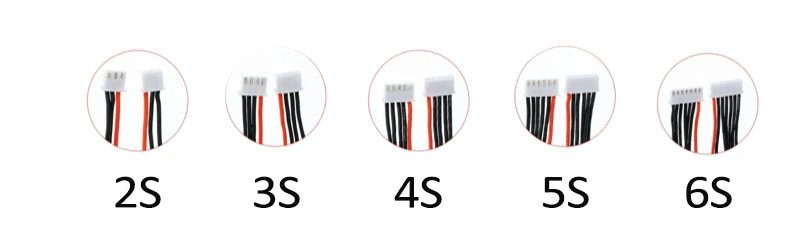
1. Check the balancing connector.
- 1S (3.7V): No balancing connector. It only has two power wires (red and black).
- 2S (7.4V): There are 3 wires in the balancing connector.
- 3S (11.1V): There are 4 wires in the balancing connector.
2. Check the battery label.
Most battery labels or markings clearly indicate basic battery information, such as 502535 7.4V 400mAh battery, which indicates a 2S 7.4V battery.
3. Touch the cell structure
Battery packs consist of stacked cells. You can feel the number of cells inside by touch.
Best Practices for Charging 3.7V 1S LiPo Battery
3.7V 1S polymer batteries do not require balancing charging, but they must strictly adhere to the CC/CV charging protocol. Charging begins at a constant current of 4.2V at 0.5C until the voltage reaches 4.2V, then switches to constant voltage charging, maintaining the voltage at 4.2V while the current gradually decreases. Charging is complete when the current drops to 10% of the initial current.
We recommend a charging rate of 0.5C to 1C. For example, for a 500mAh 1S battery, a 1C charging current is 500mA.
We recommend all 3.7V batteries be equipped with a protection circuit module (PCM), which provides critical protection against overcharging (above 4.25V), over-discharging (below 3.0V), and short circuits. Click to view our high-performance 3.7V lithium polymer battery.
The Necessity of Balance Charging for 2S & 3S Battery Pack
2S or 3S battery packs should be charged evenly. Even with high-precision cell manufacturing and assembly, slight differences in internal resistance and capacity over time can cause some cells to charge faster than others.

The JST-XH balancing charger can monitor each individual cell. If a cell’s voltage rises too quickly, the charger will divert the excess current from that cell, ensuring all cells reach 4.2V simultaneously.
In practice, we’ve found that some 3S polymer battery protection boards, due to space constraints, can only be configured with basic protection and lack balancing functionality. This necessitates that end-product manufacturers upgrade the mainboard to further monitor the charging status of each cell via software.
Optimizing Charge Current and C-Rating for Battery Longevity
The C-rate refers to the charging or discharging current relative to the battery capacity. A 1C rate means the charging current equals the battery capacity. For example, a 3.7V 200mAh battery has a 1C current of 0.2A and a 0.5C current of 0.1A.
A charge/discharge rate of 0.5C – 0.8C is the optimal range for maximizing battery cycle life and minimizing internal heat generation and lithium plating on the anode.
The upper limit for conventional battery charge/discharge rates is 1C. Our datasheets clearly state the maximum charge/discharge current.
It is also recommended to charge within the 0 ~ 45℃ range to avoid extreme ambient temperatures affecting charging performance.
Common Safety Warnings for LiPo Battery Charging
Never charge unattended. Even with charging protection, you may still encounter rare hardware malfunctions or internal short circuits, which can help control a localized fire.
Before charging, inspect the battery’s appearance. If the battery is bulging or has a pungent odor, stop using it immediately.
Ensure the connectors are clean and securely installed to avoid incorrect voltage readings that could lead to overcharging.
Conclusion
Safely charging your 3.7V, 7.4V, and 11.1V batteries requires a standard charger, adherence to the CC/CV protocol, equalization charging, and an appropriate charging rate.
Hongyitai is a professional lithium battery factory in China. Our services go beyond simply supplying battery cells. Our engineering team focuses on developing customized 1S, 2S, and 3S solutions that integrate high-performance BMS and PCM systems to meet your specific needs.