
Hongyitai is a full-chain manufacturing plant from battery cells to battery packs. We produce high-rate drone battery that meet UN38.3 and 2026 international safety standards. Our UAV LiPo battery solution with a built-in intelligent BMS eliminates concerns about safety hazards and mid-operation power outages.
Table of Contents
ToggleHow to select drone li ion battery
When choosing a drone lithium battery, you need to focus on three core factors: voltage, capacity, and discharge rate.
We have over 10 years of experience in cell chemistry R&D and automated production lines, providing you with a wide range of battery options, covering 2S (7.4V) for micro drones, 3S (11.1V) for entry-level aerial photography, 4S-6S (14.8V-22.2V) for professional models, and even a full range of high-voltage 51.8V specifications. Capacities range from 1500mAh to 36000mAh, with different discharge rates from 15C to 60C.
Based on your specific UAV needs, we provide precise discharge curve data, allowing you to avoid the potential risks of inaccurate power matching and rapid battery depletion in high-altitude and low-temperature environments.
Drone battery pack types
We produce three types of batteries: lipo, lithium-ion, and lifepo4, with lipo being the mainstream choice.
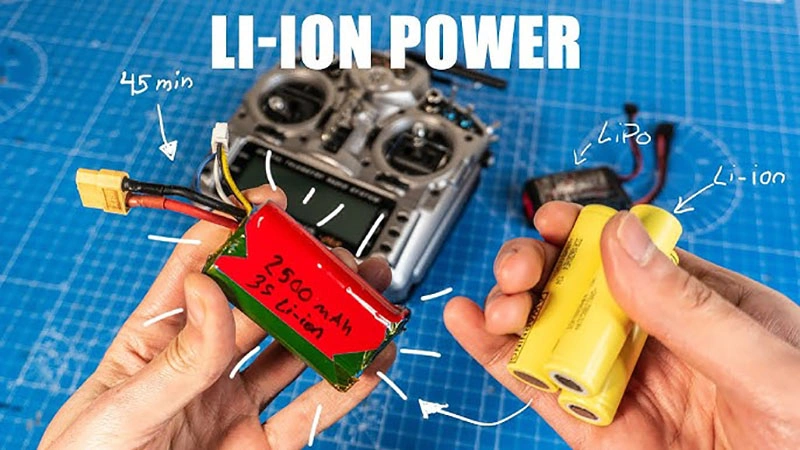
1. Lipo battery: Highest energy density, supports a maximum discharge rate of 100C, suitable for FPV racing and aerial photography drones.
2. Li-ion battery: 1000+ cycle life, safe, commonly used in logistics and long-endurance industrial drones.
3. Lithium iron phosphate battery: High temperature resistance, highest safety, suitable for security monitoring scenarios.
We are dedicated to serving different brands, from FPV racing drones to heavy-duty agricultural drones, solving problems such as unstable voltage, unbalanced center of gravity, and insufficient energy density, so that you can get the most suitable drone battery type for you.
Drone Type VS Battery Application
We provide batteries for all scenarios, from high-rate FPV drones to long-endurance VTOLs, covering various applications such as agricultural plant protection, forest fire prevention, and surveying and inspection. Based on our years of experience in customizing and manufacturing drone battery, we have compiled the following summary table.
| Drone battery types | Battery types | Typical Specs | Advantages |
|---|---|---|---|
| FPV racing | Lipo | 4-6S, 1100-1500mAh, 60C+ | High power, agile |
| Aerial photography | Lipo | 4-6S, 1300mAh, 50-60C | Flexible, balanced battery life |
| Industrial Logistics | Li-ion / LFP | 24S, 24Ah, 10-20C | Long lifespan, safe |
Standards for drone battery compatibility

We possess a complete international certification system and advanced quality control laboratory. Every drone battery we produce strictly adheres to UN38.3, CE, and UL1642 standards.
- Voltage Compatibility: Our cell series connection is precisely matched to your motor requirements. For example, if your drone motor is 12V, we recommend using a 3S (11.1) Li-ion battery to avoid overheating and damaging components.
- Discharge Current: C-value × capacity (Ah) ≥ motor peak current. For example, if your drone’s maximum discharge current is 130A, you can refer to a 5Ah 30C drone battery.
- Size/Weight: Our batteries are smaller than the battery compartment space, maintaining a thrust-to-weight ratio of 1.5 to 3, ensuring your drone’s maneuverability.
- Protection Board: Our intelligent BMS provides overcharge, over-discharge, and temperature control functions. We also offer batteries without protection boards for model aircraft.
- Connectors: XT60 & EC5 are the two most commonly used plugs. You can click here to view more lipo battery connectors.
How to keep UAV drone battery healthy
Our precise BMS features active balancing, accurate coulomb counting, and remote communication capabilities. It is also crucial for proper charging and discharging, temperature control, and storage habits. This addresses pain points for users in real-world applications, such as cell damage caused by overcharging and over-discharging, high maintenance costs, and deterioration in drone battery pack consistency.
Charge and discharge
If you do not use the drone battery for more than 10 days, discharge it to 40% to 65% capacity before storing. Charge and discharge the battery approximately every 3 months to activate its activity and extend its lifespan. Avoid deep sleep mode or over-discharge if the drone battery is underpowered for extended periods.
Maintenance for drone battery
Visual inspection: After every 20 flights, check the drone battery for bulging/leakage. If any abnormality is found, stop using it immediately.
Top 5 FPV drone battery suppliers recommended
Through long-term tracking of leading drone battery brands’ performance in High-C rate discharge stability and cell consistency, we have compiled the following list of 5 drone battery manufacturers for your reference:
1. Hongyitai: High cost-performance ratio, specializing in customized 3S, 4S, and 6S 1100-3600mAh 100C+ batteries, durable and reasonably priced.
2. Gens Ace: High-C-value LiPo batteries (6S 1300mAh 120C) specifically for FPV, low internal resistance, stable voltage, the first choice for racing.
3. Tattu: Professional FPV series, precisely matched to 5-inch aircraft, lifespan up to 300+ cycles, supports fast charging.
4. Venom Power: Built-in protection circuit, suitable for long-distance flights, complete certifications.
5. HRB: Emerging dark horse, high discharge (150C peak), commonly used in FPV competitions, lightweight.
FAQs about uav drone battery
After flight, cool down to 40℃ before charging. Use a 1C rate balance charger to charge, and monitor the voltage of each cell to ≤4.2V throughout the process.
If you find the battery temperature to be below 15°C or above 60°C, please return to base immediately. Before flying in winter, preheat the battery to above 10°C.