
Many people are confused about NMC, LCO, and LMO batteries, mainly due to differences in their cathode materials. This article will give you a thorough understanding of these differences in just 3 seconds, and show you which products each type is suitable for.
Table of Contents
ToggleLCO vs NMC vs LMO Chemistry: Technical Comparison
LCO, NMC, and LMO are three common lithium-ion battery cathode materials, but their chemical compositions differ, mainly in the types and proportions of metal elements, which determine their crystal structure and performance.
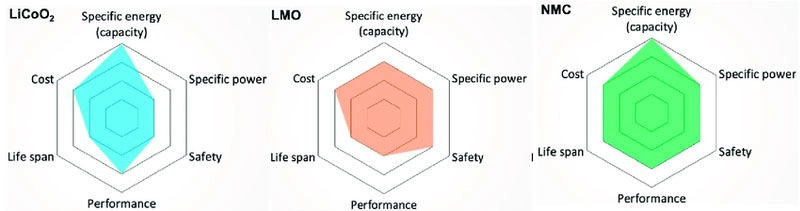
- LCO: LiCoO₂, a pure cobalt-based layered oxide structure.
- NMC: LiNiₓCoᵧMn₁₋ₓ₋ᵧO₂, a ternary layered solid solution with a variable Ni/Co/Mn ratio (e.g., NMC111: LiNi₁/₃Co₁/₃Mn₁/₃O₂).
- LMO: LiMn₂O₄, a spinel structure with cobalt substituting for manganese in the layered structure.
The following is a multi-dimensional technology comparison table of LCO batteries, NMC batteries, and LMO batteries:
| Parameters | LCO (LiCoO2) | NMC (LiNiMnCoO2) | LMO (LiMn2O4) |
|---|---|---|---|
| Energy Density | 150 - 200 Wh/Kg | 150 - 220 Wh/Kg | 100 - 150 Wh/Kg |
| Nominal Voltage | 3.6V | 3.7V | 3.70V - 3.80V |
| Cycle Life | 500-1000 | 1000-2000 | 300-700 |
| Cost | High | Middle | Low |
Energy Density & Performance
LCO batteries are renowned for their superior volumetric energy density, making them the preferred choice for small consumer electronics products and a key area of research and development for many lithium battery manufacturers. However, NMC (nickel-cobalt-manganese) batteries, by adjusting the proportion of nickel, are rapidly catching up to LCO batteries in terms of energy performance and offering longer battery life.
Cycle Life
In terms of cycle life, NMC battery chemistry shows a clear advantage. Our NMC batteries, manufactured by Hongyitai, can easily achieve 1000+ cycles, while LCO batteries show significant capacity degradation after 500-800 cycles. If you require an extremely long standby time, you should consider NMC batteries.
Safety & Thermal Stability
Safety is a primary consideration for industrial applications. LMO batteries, with their spinel structure and a maximum thermal runaway temperature of 250°C, offer the highest safety. In contrast, LCO batteries are more sensitive and prone to thermal runaway under overcharging or high temperatures. Lithium NMC batteries fall somewhere in between, and their safety can be improved by incorporating a highly efficient PCM.
Cost
LCO batteries contain a large amount of expensive cobalt, making them the most expensive: RMB 400,000 per ton. NMC batteries are the second most expensive, at RMB 180,000 per ton, while LMO batteries are cheaper, at RMB 54,000 per ton. LCO battery prices are highly susceptible to fluctuations in international mining prices; click the link to view daily price fluctuations.
How to Choose the Right Battery for Your Application?
If you are designing wearables, TWS earbuds, or other compact devices, LCO batteries are the preferred choice due to their high energy density and small size.
If your product is for electric vehicles and power tools, NMC batteries are the best option because of their superior energy density and long cycle life.
If your product is for medical devices and specialized industrial equipment, LMO batteries perform better because of their excellent thermal stability and low internal resistance, meeting the requirements for ultra-long standby time.
We can provide all aboved 3 li-ion battery types, please study our lithium polymer battery products.
FAQs About NMC vs LCO vs LMO Battery
These figures represent the proportions of nickel, cobalt, and manganese.
NMC 111: Balanced proportions, longest cycle life, and best thermal stability.
NMC 532 & 622: Achieve excellent balance between energy density and safety.
NMC 811: The latest high-performance trend. Significantly improves energy density by increasing the proportion of nickel, while greatly reducing the cobalt content.
LFP (Lithium Iron Phosphate) batteries have a high thermal runaway temperature (approximately 270°C+), and they rarely smoke or catch fire under physical damage, making them safer than lithium NMC batteries.
NMC batteries typically have 30% higher energy density than LFP batteries, allowing them to store more energy in the same space.
For space-constrained portable energy storage, NMC batteries are the preferred choice; for large-volume energy storage projects, LFP batteries are more advantageous.
You can study NMC vs LFP battery comparison further information here.
The chemical structure of LCO batteries is unstable. After multiple charge-discharge cycles, the crystal structure of lithium cobalt oxide is prone to irreversible collapse, resulting in less and less electricity being released. This is why our mobile phone batteries do not last long after a year of use.