
Many people confuse OEM batteries and ODM batteries. This article will clarify the differences in one minute, allowing you to quickly see the essential differences between the two and choose the model that suits you best.
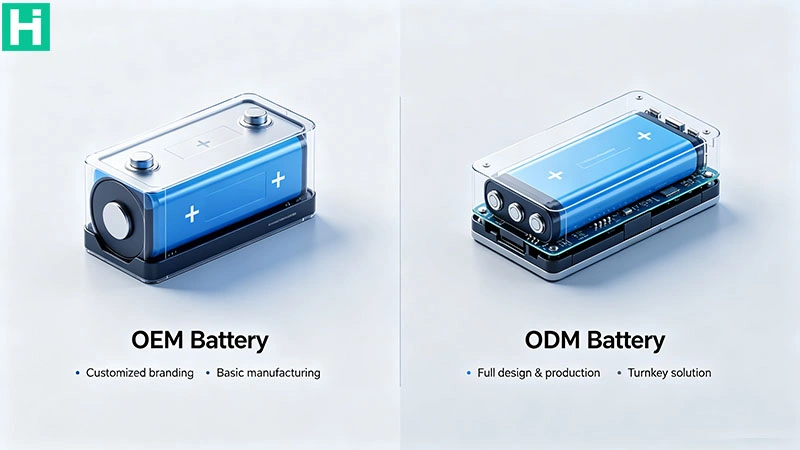
Table of Contents
ToggleCustomization Depth: From Branding to BMS Engineering
OEM battery internal structures, cell types, and circuit designs are mature and stable, such as the 12V 100Ah LifePO4 battery, allowing you to enter the market with minimal cost and maximum speed.
ODM batteries involve remolding protection boards and housings, customizing them to meet your dimensions, waterproof ratings, and interface types. We have helped over 100 customers redesign their BMS: RS485, RS232, CANbus, and equalization functions.
Intellectual Property (IP) Ownership
OEM battery: The product’s technical solutions (internal circuit design, BMS firmware, and mold) belong to the factory; you only have the brand sales rights for this product in a specific region.
ODM battery: The factory and you jointly develop the product, and you enjoy the intellectual property rights, including but not limited to the battery casing and BMS design. The factory has no right to resell these to your competitors.
Time-to-Market
OEM battery: Fast, initial shipments can be completed in 2 to 4 weeks, as the factory has already completed cell selection, circuit testing, and safety certification.
ODM battery: Slower, 2-3 months, engineers need to perform BMS engineering development, PCB design, and 3D structural modeling. If UL certification needs to be reapplied for, it will take even longer.
OEM vs ODM Production Workflows
OEM Battery: An extremely streamlined workflow. Confirm your requirements (voltage, capacity, size, power), you send your logo and printing materials, the factory sends samples, and mass production can begin once confirmed.
ODM Battery: Deep engineering collaboration. Both parties discuss requirements in detail, including communication protocols (CAN/RS485), extreme environment operating requirements, and physical limitations. The factory provides detailed technical datasheets, BMS circuit schematics, and 3D structural designs. 1-3 hand-made prototypes are produced for rapid verification and testing. Custom molds are then created, and small-batch trial production is conducted to verify the stability of the production process. Once everything is confirmed to be correct, mass production begins.
Investment & MOQ
OEM battery: Low barrier to entry, no additional R&D costs required, you only need to pay for the goods. MOQ: Minimum order of 10 units.
ODM battery: You need to pay for BMS R&D and mold development, and possibly UL certification. MOQ: 500 units, depending on the depth of your cooperation.
When to Choose OEM or ODM Battery Systems?
OEM batteries are suitable for rapid market entry and low operating costs, especially lead-acid to lithium conversion batteries. They already offer mature and stable OEM solutions, allowing you to focus your investment on brand marketing.
ODM batteries are suitable for building a long-term competitive advantage through technological leadership or unique experiences. Check out our custom lithium battery packs to meet specific application needs and avoid price wars.
Conclusion
Competition in the lithium battery industry has long since evolved from a simple price war for battery cells to a battle of system integration and customization capabilities. If you are unsure which model is right for you, contact us for assistance.