
Whether you’re a factory seeking stable power or a supplier focused on grid frequency regulation, you’re looking for efficient battery energy storage system solutions. This involves understanding how to operate in industrial environments and finding the right energy storage system manufacturer for your needs.
In this guide, we provide a comprehensive overview, from core components and operating principles to application scenarios, to help you make informed decisions for your next energy storage project.
Table of Contents
ToggleCore components of BESS

A complete BESS (Battery Storage System) is a highly integrated system, mainly composed of the following 3 parts:
1. Battery System (The Heart)
LiFePO4 cells: Primarily composed of LiFePO4 (Lithium Iron Phosphate) cells, which offer higher thermal stability and a cycle life of over 6000 cycles compared to NMC lithium batteries.
Battery modules & racks: Cells are connected in series and parallel to form battery modules, which are then further integrated into battery racks to form a highly efficient energy storage system.
2. Battery Management System (The Brain)
It monitors the voltage, current, and temperature of each cell in real time, preventing overcharging, over-discharging, and overheating. Through active balancing, it ensures that each cell remains highly consistent, thereby extending the lifespan of the entire system.
3. Power Conversion System (The Bridge)
It is responsible for bidirectional energy conversion between the battery (DC) and the power grid (AC). During charging, AC power is converted to DC power and stored in the battery; during discharging, DC power is converted to load power to provide power to the device.
How does battery energy storage system work?
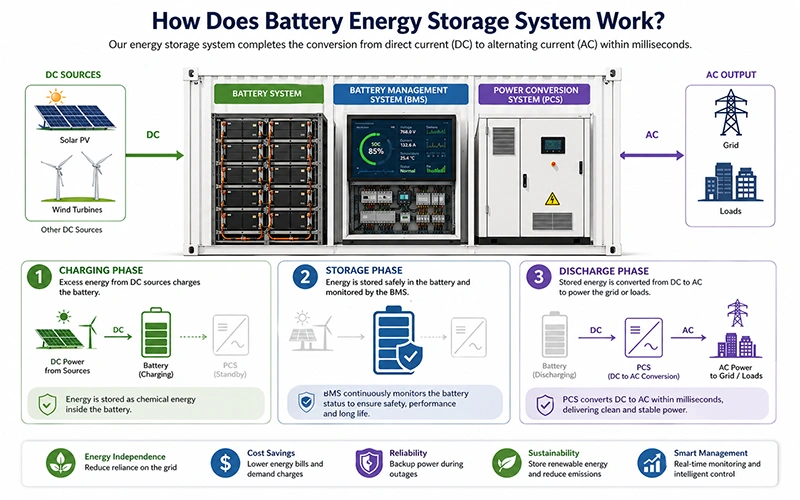
BESS operates on the principle of energy storage and release. Our energy storage system completes the conversion from direct current (DC) to alternating current (AC) within milliseconds, roughly divided into the following three stages:
The Charging Phase: Collecting energy. When the solar panel’s power generation exceeds the total load demand, the external AC power begins to be converted to DC power and stored in the battery modules as chemical energy.
The Storage Phase: Preserving power. Once the battery is fully charged, the system enters monitoring mode. The BMS continuously monitors the cell’s state of health (SOH) and state of charge (SOC).
The Discharge Phase: Providing power. When there is a power outage, peak electricity demand (high electricity prices), or the photovoltaic system stops working, the system quickly (less than 20 milliseconds) switches to discharge mode to power your air conditioners, lighting, electric stoves, laptops, cameras, and other loads.
BESS applications: from factories to remote grids
BESS can adapt to different power supply scenarios ranging from kilowatt-hours (kWh) to hundreds of megawatt-hours (MWh).
- Industrial & Commercial: By charging during off-peak hours and discharging during peak hours, you can significantly reduce your electricity bills. Many precision manufacturing industries in Shanghai (semiconductor, lithium battery production lines) cannot afford even a one-second power outage; they have installed large battery energy storage systems to mitigate the risk of equipment damage during power outages.
- Utility-Scale – The Grid Stabilizer: Solar and wind power are intermittent. Our energy storage system can store solar power at midday for use during evening peak hours, ensuring a stable power supply 24/7.
- Microgrids & Remote Areas: Combined with solar power systems, BESS allows remote areas to become energy self-sufficient, eliminating the need for expensive diesel generators. In disaster-prone areas, home battery energy storage systems are a lifeline for ensuring residents’ basic needs.
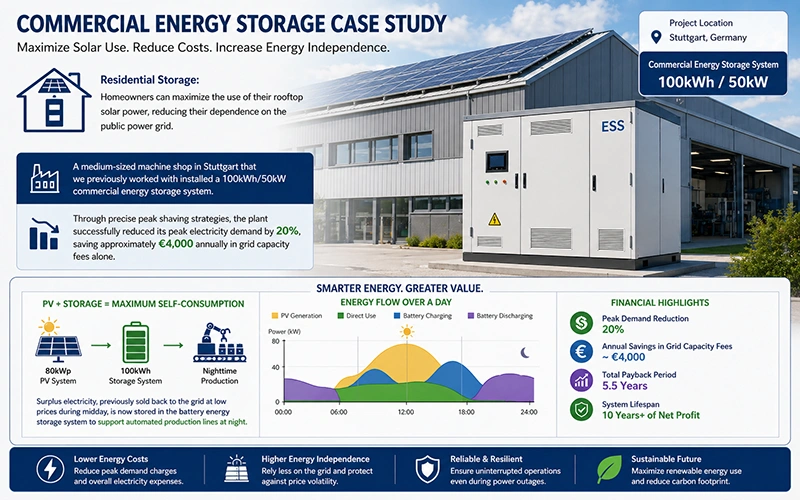
- Residential Storage: Homeowners can maximize the use of their rooftop solar power, reducing their dependence on the public power grid. For example, a medium-sized machine shop in Stuttgart that we previously worked with installed a 100kWh/50kW commercial energy storage system. Through precise peak shaving strategies, the plant successfully reduced its peak electricity demand by 20%, saving approximately €4,000 annually in grid capacity fees alone.
Combined with its existing 80kWp photovoltaic system, the plant achieved a significant leap in energy self-consumption. Surplus electricity, previously sold back to the grid at low prices during midday, is now stored in the battery energy storage system to support automated production lines at night. Considering both electricity price arbitrage and the benefits of photovoltaic coupling, the project’s total payback period is only 5.5 years, and it will continue to generate net profit for the plant over its next 10-year lifespan.
How to design your own battery energy storage system?
Below is Hongyitai efficient BESS (Battery Escalator Service) design process:

1. Identify Your Energy Profile. We will collect the following information: What is the maximum power your equipment operates at at any given time? How much electricity do you consume on average each day? What percentage of this do you want BESS to cover?
2. Based on your application needs, if your goal is long-term power supply (more than 4 hours of backup power), we will design a system that focuses more on energy density. If you need to cope with the instantaneous surge during high-power machine startup, we offer high-rate cells.
3. Environmental Adaptation. In hot regions, we recommend liquid cooling technology, which can control cell temperature more evenly than traditional air cooling, extending cycle life by 20%. For coastal projects, we will enhance the system’s resistance to salt spray corrosion; for outdoor projects, we recommend an IP55 sheet metal enclosure.
If you have capacity anxiety, we recommend a modular design, allowing you to start with a small capacity; as your power consumption increases, you can then expand the capacity.
Backup power limitations
However, you also need to be aware of the limitations of energy storage systems to help you mitigate risks in advance.
Limited Energy: Unlike diesel generators, BESS stores a fixed amount of electricity. If your system capacity is 100kWh, it can only support a 50kW load for 2 hours under full load discharge.
Discharge Rate Limitation: Some high-power motors generate 5-7 times the current during startup compared to operation. If the instantaneous discharge rate (C-rate) of the battery energy storage system is insufficient, it may trigger the system’s self-protection mechanism, leading to a power outage.
Temperature Sensitivity: In extremely cold (below -20°C) or extremely hot (above 45°C) environments, the battery’s charge and discharge efficiency will decrease.
Not a Complete Grid Replacement: If there is no sunlight for several consecutive days and the grid is down, the system will eventually run out of energy.
Acknowledging limitations does not mean that energy storage systems are inferior. Please contact us in advance to mitigate potential risks.
How to select reliable battery energy storage system manufacturers

When evaluating battery energy storage system manufacturers, please consider the following four dimensions:
Verification of safety & certifications: Safety is the bottom line. We can provide UN38.3, UL1642, and IEC62133 reports, allowing you to quickly enter your local market.
Vertical integration & R&D capability: Our professional R&D team is proficient in core materials such as battery cells, BMS, and communication protocols. When system failures occur, we can troubleshoot from the ground up and respond quickly.
Track records & case studies: You can consult the manufacturer for case studies of similar application scenarios.
After-sales support & warranty reliability: What specific after-sales services can the factory provide? Can they provide remote technical support? Can they offer timely on-site technical guidance?
Hongyitai is a professional factory in the lithium battery industry. We have not only passed the stringent tests of UL and IEC, but have also established a complete service system from “electricity demand simulation” to “after-sales full lifecycle monitoring.” Contact us for high-quality BESS.
FAQs about battery energy storage system
Yes. Modern BESS systems support both modes. When connected to the grid, it can perform electricity price arbitrage; when the grid is down, it can instantly switch to off-grid mode to provide independent power to your load.
The system design life of LiFePO4 cells is 10-15 years. Its core depends on the number of cycles; our systems typically support over 6000 deep cycles (80% DoD).
Absolutely. While it works even better with solar power, you can absolutely use BESS for simple electricity price arbitrage or as a pure backup power source.