
The battery energy storage system (BESS) is no longer just a backup power source; it’s a crucial strategy for cost reduction, transforming unpredictable solar energy into a controllable energy storage system.
This article will delve into the technical architecture of BESS, the collaborative logic of its core components, and how it creates additional value for industrial and residential energy storage users through application scenarios such as peak shaving and demand charge reduction.
Table of Contents
ToggleHow Battery Energy Storage Systems Work
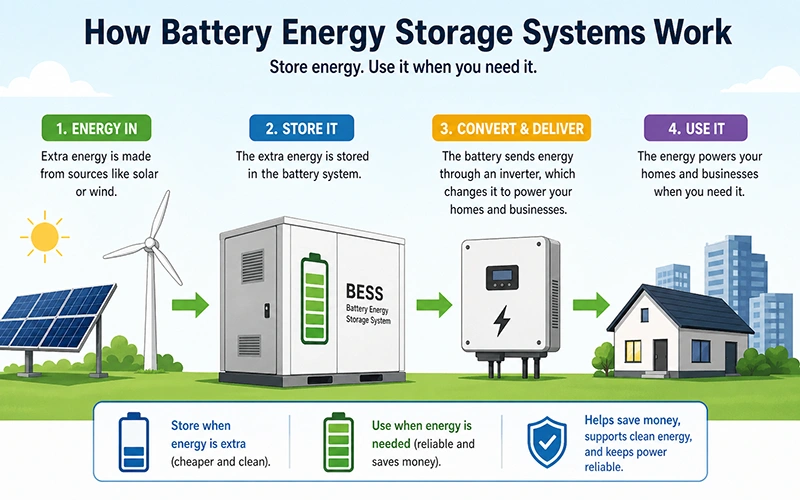
Our battery energy storage system (BESS) operates by converting solar energy into electrical energy. It is designed not only to store electricity but also to distribute it rationally, all of which require precise collaboration of core components.
BESS Operational Architecture: From Battery Strings to Grid Interaction
- Energy Capture & Storage (battery pack): Dozens or hundreds of LiFePO4 cells are strictly combined in series and parallel to form alloy strings. When the grid is in a downtrend or photovoltaic power generation is in surplus, direct current (DC) fully charges the internal cells. Click to see how to connect LFP batteries in series.
- Power Conversion (PCS): The battery stores DC power, but most industrial loads and the grid use alternating current (AC). In this case, the PCS acts as a bidirectional converter, converting AC to DC during charging and inverting DC to AC during discharging.
- Intelligence Control (EMS): The top-level EMS (energy management system) is responsible for grid interaction with the grid. It determines when the system stores or releases energy based on real-time electricity price signals or load demand.
The Role of Smart BMS and PCS in Energy Conversion
BMS (Battery Management System): Like the brain of the entire system, it’s the core safety defense line. It monitors the voltage, current, and temperature (SoC and SoH) of each battery module in real time. During energy conversion, the BMS uses active and passive balancing to synchronize the charging and discharging of all cells, preventing overheating or overcharging and ensuring the entire system operates smoothly for over 10 years.
High-Efficiency PCS: All industrial-grade PCS manufactured by Hongyitai possess extremely high conversion efficiency (>98%) and millisecond-level response speed. Upon detecting grid frequency fluctuations or sudden power outages, the PCS can complete a seamless switchover within 20ms, preventing damage to factory or household equipment due to power outages.
Economic and Operational Benefits for Industrial Applications
The logic behind installing BESS (Build-Easy Power Supply) is very clear: through intelligent power dispatching, it transforms volatile energy costs into predictable operational benefits. They are commonly used in residential energy storage, off-grid and grid-connected systems, factories, data centers, hospitals, and communication equipment.
Demand Charge Reduction, Peak Shaving, and Emergency Backup
In industrial electricity consumption, electricity costs constitute a significant portion of the overall bill. You can reduce these costs in the following 3 ways:

- Peak Shaving: Energy storage systems monitor the factory’s real-time load and automatically release stored energy during peak hours, reducing the peak power absorbed from the grid. For example, one of our US manufacturing plants has large machinery that generates short power spikes daily from 4 PM to 9 PM (peak hours). These 15 minutes of peak power are extremely high, resulting in demand charges accounting for over 40% of the monthly electricity bill. With a 1,000kW energy storage system, the monthly electricity bill was reduced by $4,000, resulting in a reduction of $48,000 annually.
- Energy Arbitrage: Utilizing time-of-use tariffs, the system charges at night when electricity prices are low and supplies power to the load during the day when electricity prices are high. In high-electricity-price regions such as California, Germany, or Australia, this arbitrage model can shorten the payback period to 3-5 years.
- Emergency backup: For industries with “zero tolerance” for power outages, such as semiconductors, precision manufacturing, or cold chain logistics, we offer UPS-grade protection. It responds faster than traditional diesel generators and has no maintenance costs.
Comparison of Battery Chemistries for Large-Scale Storage
In the BESS market in 2026, although there are many different technologies, each technology has its specific application boundaries.
In the commercial and utility-scale energy storage sector, LiFePO4 (LFP) has achieved absolute dominance. Compared to NMC batteries, LFP batteries have a higher thermal runaway threshold (approximately 270°C vs. 210°C for NMC). LFP systems can provide 3,000 to 6,000 full cycles, while NMC batteries can sustain around 1,000 cycles.
Below is a comparison of LiFePO4 vs. NMC vs. lead carbon vs. flow battery.
| Feature | LiFePO4 (LFP) | NMC (Nickel Manganese Cobalt) | Lead Carbon | Flow Battery |
|---|---|---|---|---|
| Cycle Life | 3,000 - 6,000+ | 1,500 - 2,500 | 800 - 1,500 | 10,000+ |
| Safety | Very High | Moderate | High | Excellent |
| Energy Density | Moderate | High | Low | Very Low |
| Best For | C&I Storage, Grid Support | EVs, Portable Tech | Budget Backup | Long-Duration Storage (8h+) |
Conclusion
From sophisticated BMS safety monitoring to complex Peak Shaving algorithms, every energy storage technology helps you reduce costs and ensure energy security. A good energy storage system is not about buying a bunch of LiFePO4 cells, but about choosing an asset that can deeply interact with the grid and operate stably over the long term.
Whether you are looking to improve your plant’s energy resilience or want to achieve true ESG compliance through a combination of photovoltaics and energy storage, Hongyitai can provide you with comprehensive support from technical consulting to system delivery.