
Despite the increasing maturity of LFP battery technology, the initial investment in energy storage systems remains substantial, a key factor hindering project implementation. Many people are constantly searching for cheaper quotes, worrying about whether buying now is too expensive and whether prices will fall in the future.
Today, we explore 4 feasible price reduction methods, combined with sodium-ion battery technology, to provide you with a complete purchasing guide.
Table of Contents
Toggle4 ways to reduce battery energy storage system kWh cost
Simply relying on lowering the price of lithium iron phosphate battery cells is not a wise business strategy. With China subsequently canceling export tax rebates for batteries, you can reduce costs through the following refined operational and procurement methods.
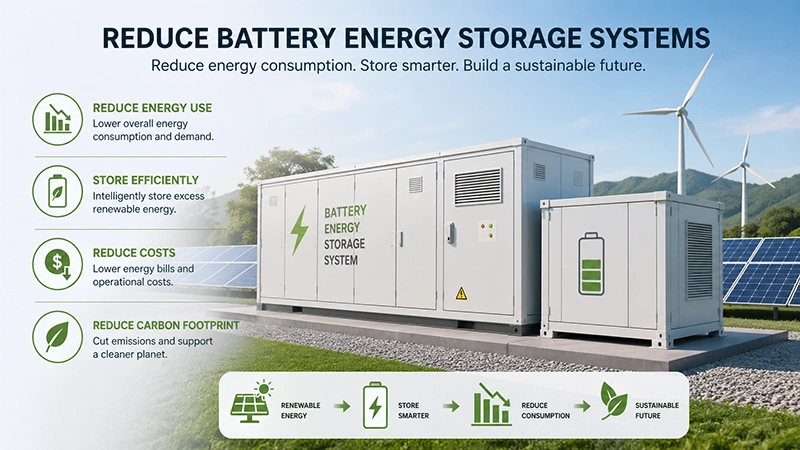
Here are 4 practical paths to reduce battery energy storage system kWh cost:
Factory direct supply
Directly connect with OEM/ODM factories: You can find factories located in industrial clusters such as Shenzhen, Dongguan, and Huizhou. Their supply chains are mature and stable, their prices are competitive, and they can quickly respond to your specific needs.
You can also sign dynamic pricing agreements with manufacturers for lithium carbonate index, ensuring that your purchase price decreases in tandem with falling raw material prices.
Modularization and pre-assembly
Overseas installation costs can account for 15%–25% of total expenditure. You might consider an all-in-one battery solution, allowing your supplier to handle the integration of BMS, PCS, and thermal management in a modular BESS.
Upon receiving the energy storage system, it’s plug-and-play, reducing the risk of unforeseen events in the field.
Precise proportions

You don’t need to over-configure your energy storage system. Simply assess your electricity load curve and select the most suitable power and capacity, prioritizing systems that can be expanded later to reduce your initial investment costs.
One Vietnamese factory initially installed only a 500kWh modular BESS to meet current peak-valley arbitrage opportunities, instead of blindly installing a 1MWh system, which reduced its initial capital by 40%. 2 years later, with production line expansion, the factory directly expanded its capacity using reserved slots, avoiding initial capital tied up and benefiting from a 15% drop in battery cell prices two years later, achieving true on-demand investment.
Optimize EMS charging and discharging strategies
You can optimize depth of charge/discharge (DoD) and temperature control through an AI-driven EMS (energy management system), extending cycle life to 8000 cycles.
Excellent software allows the system to provide frequency response services while participating in energy arbitrage, thus indirectly reducing the cost per kWh.
Will BESS prices continue to fall in the next years
According to the latest BloombergNEF industry report, the unit price of BESS (Battery Safe Storage System) continues to decline, but the rate of decline has slowed.
The average cost of a global 4-hour energy storage system is projected to be $75–$95/MWh in 2026. By 2030, with further scaling up manufacturing, the total cost is expected to decrease by another 25%–30%.
In 2020, cell costs accounted for 60% of the total system cost; by 2026, the cost share of cells and modules has decreased to 25%–45%. Learn more about battery cost disconnect in details.
Is now the right time to buy?
If you’re debating whether to wait until 2027 to place your order, consider these two practical factors:
Energy storage systems are a productivity investment. Waiting a year might save you 3%-5% on equipment purchase costs, but you could lose 12 months of energy arbitrage benefits or the production security provided by backup power.
Many regions are currently implementing green energy subsidies and tax rebates (the US ITC or Southeast Asia’s green tax exemption). Delaying your purchase could cause you to miss out on the highest percentage of rebates, a loss far exceeding the amount of hardware price reductions.
Which technologies can further reduce prices
Besides fluctuations in raw material prices, technological advancements in 2026 will also drive down battery energy storage system prices. The following two technological approaches will help you reduce costs:
Sodium-ion

In 2026, sodium-ion batteries officially entered the mass production stage, becoming a strong competitor to LFP batteries.
Sodium is extremely abundant and widely distributed in the Earth’s crust, eliminating the need to rely on expensive lithium resources. According to the latest data from CATL, the production cost of sodium batteries is approximately 20%–30% lower than that of LFP batteries.
High voltage system
Currently, large-capacity energy storage systems are undergoing a comprehensive upgrade from 1000V to 1500V architecture.
Once the voltage is increased, less current is drawn when transmitting the same power. This allows for reduced cabling, lowers overall system resistance losses, and reduces the overall electrical infrastructure cost by 5%–10%.
Conclusion
Battery energy storage system prices entered a relatively rational and stable period in 2026. While the cost per kWh still has room to decrease, simply waiting could mean missing out on expensive energy arbitrage opportunities.
The essence of energy storage investment is not buying a set of hardware, but rather buying a tool that can continuously reduce your electricity costs over the next 10-15 years. See our wall-mount energy storage and stackable battery energy solutions.
FAQs about Battery Energy Storage System Price
You can check if the supplier uses Grade A cells and request the corresponding UL/CE/IEC certification reports. At the same time, examine the supplier's BMS R&D capabilities, as this is crucial in determining the system's lifespan.
It depends on local electricity price differences. In areas with large peak-valley price differences, combined with tax incentives, the current average investment payback period has been shortened to 4.5–6 years.