
With the increasing number of installed battery energy storage systems, an unavoidable question arises: are these systems safe? This concerns asset security, operational safety, and thermal runaway risks.
Today, from the perspective of a lithium battery manufacturer, we’ll guide you through understanding why modern energy storage systems prioritize safety, considering factors such as LiFePO4 material, BMS monitoring, and compliance.
Table of Contents
ToggleHow LiFePO4 Chemistry Enhances Safety in Battery Energy Storage Systems
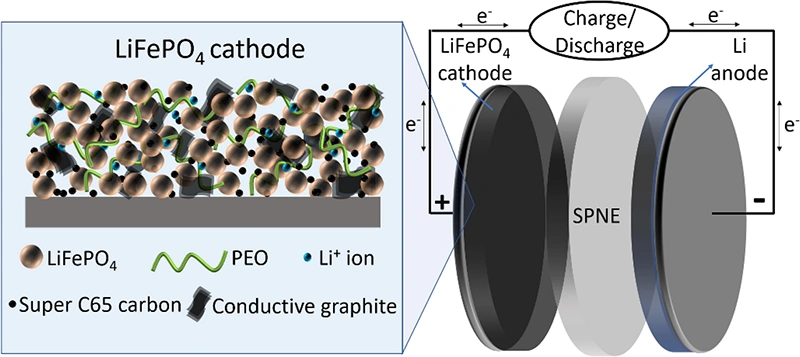
Most global energy storage system cells are made of LiFePO4, which has the following significant advantages:
1. High stability. The thermal runaway critical point of LFP cells is 270℃, higher than the 180℃ of NMC batteries. Even if LFP decomposes, it does not release oxygen, reducing the risk of explosion.
2. High safety. Our tests showed that when a steel needle penetrated the cell to induce an internal short circuit, the LFP cell rarely emitted smoke, and its surface temperature remained below its ignition point.
3. Long cycle life. LFP batteries can withstand 6000+ charge-discharge cycles, or 10 years of operation. LFP cells are less prone to lithium dendrite formation, resulting in lower safety risks.
Intelligent BMS Ensures BESS Safety
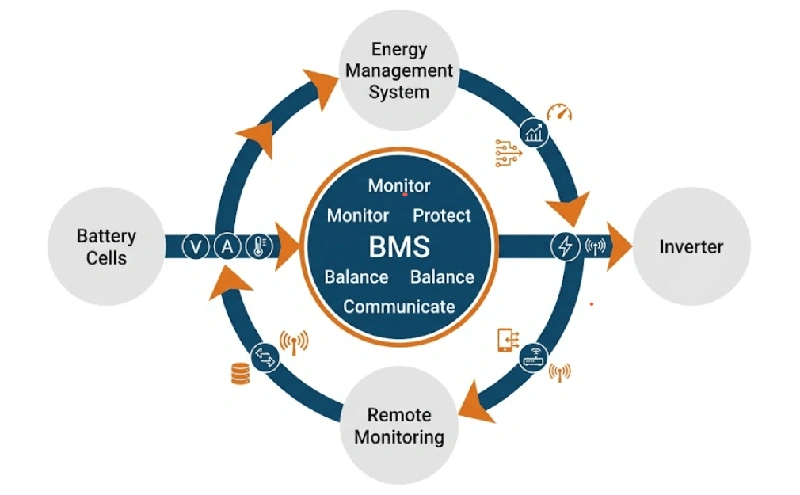
The battery management system (BMS) acts as the brain of the entire energy storage system, preventing accidents and providing real-time monitoring.
1. Real-time monitoring and early warning: The intelligent BMS monitors the voltage of each cell, preventing overcharging and over-discharging, and detects temperature fluctuations.
2. Multi-layer protection: The BMS system alarms when approaching critical values; in case of an anomaly, it cuts off the circuit to ensure the physical safety of the entire battery energy storage system.
3. Active balancing: Our BMS can transfer high-voltage energy to low-voltage cells, correcting the weakest link in the chain and extending the system’s lifespan.
4. Data logging: The BMS records data throughout the process, allowing you to analyze State of Health (SOH) trends and proactively replace potentially risky modules.
Advanced Thermal Management and Fire Suppression
Thermal management and fire suppression management are two crucial technologies. We utilize precise physical temperature control: liquid cooling. In high-power BESS systems, liquid cooling is the preferred technology, controlling temperature differences within 3°C and improving system thermal uniformity.
Furthermore, we combine smoke and heat sensors to quickly identify and warn of small fires, ensuring you receive prompt notification and can extinguish the fire quickly, preventing large-scale fires.
BESS Critical Safety Standards
The following are the most important certifications for battery energy storage systems in 2026:
1. UL9540: This is the entry ticket to the North American market. It tests the overall reliability of the battery, inverter, and control system.
2. UL9450A: This is a test report that simulates battery thermal runaway, recording smoke composition and flame spread rate.
3. IEC62619: This is the most important standard for energy storage batteries. It verifies mechanical shock, thermal abuse, and electrical performance.
4. UN38.3 and MSDS: Ensure safe air and sea transport and help you with fast customs clearance.
Conclusion
As can be seen above, battery energy storage systems are safe for commercial use. This is all based on sound scientific and rigorous engineering design: the LiFePO4 battery chemistry, intelligent BMS, and advanced thermal management technology.
Hongyitai recommends that you examine the safety standards of the brand manufacturer to ensure you receive a stable and reliable energy storage system from the source. You can check out our high-quality stackable battery system and home powerwall energy storage system.
FAQs
Lithium iron phosphate batteries are widely recognized as the safest option currently available. They are non-flammable, highly stable, and have a cycle life of over 6000.
The risk of fire for BESS is extremely low, in the event of component failure or manufacturing defects in the energy storage system.
You can check these certifications: UL 9540 / 9540A, IEC 62619, UN 38.3, UL 1741.