
The forklift battery represents a significant expense throughout the entire operation. You might consider a cheaper forklift battery, but it comes with higher maintenance costs and a higher chance of failure. Today, we’ll discuss cost reduction from the perspective of lithium battery manufacturers, moving beyond the mindset of buying the cheapest option and focusing instead on the total cost of ownership to truly lower forklift battery costs.
Table of Contents
ToggleHow Switching to LiFePO4 Lowers Total Forklift Battery Costs
For example, a 48V 400Ah LFP battery costs approximately $7000, while a lead-acid battery costs only $3000, easily luring buyers into a low-price trap. However, considering the entire lifecycle, LFP batteries can help you save money in the following ways:
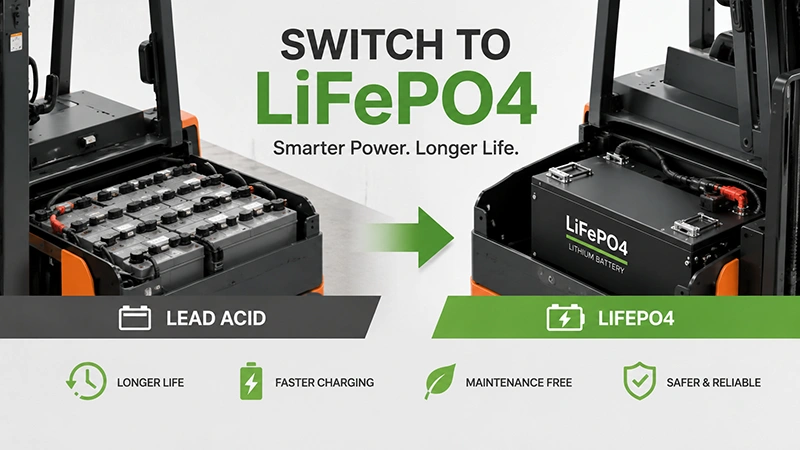
- Zero maintenance costs. LiFePO4 batteries have a built-in intelligent BMS, are 100% maintenance-free, and require no water addition, making this cost virtually zero.
- 2-3 times the cycle life. Ordinary lead-acid batteries have a cycle life of only 500-1000 cycles, while LiFePO4 forklift batteries boast 3000+ cycles. This means the latter can replace 2-3 lead-acid batteries, incurring replacement costs along the way.
- LFP batteries are convenient to use. Lead-acid batteries have strict charging requirements: 8 hours to fully charge, 8 hours to discharge, and 8 hours to cool, which can impact your warehouse operating efficiency. LFP batteries, on the other hand, can be charged and used immediately, eliminating the need to purchase spare batteries.
Reducing Costs via Bulk Purchasing Directly from the Battery Factory
We’ve observed that many overseas warehouses typically purchase from local agents. To obtain competitive pricing, we recommend sourcing directly from the factory. This eliminates intermediaries, allowing you to connect directly with the factory and reduce costs by up to 20%.
For LCL (Less than Container Load) sea freight, consider forklift-based battery consolidation for full container shipping, which lowers the shared freight costs. Additionally, you’ll need safety reports such as UN38.3, CE, and IEC to clearly state that they use Grade-A cells and do not accept disassembled or Grade B cells, ensuring high cell consistency and long cycle life.
Smart Customization: Avoiding Over-Spec Forklift Batteries
Another cost-saving blind spot is avoiding over-configuration. Bigger isn’t always better; each parameter should match your needs. Redundant configurations are unnecessary, and this is an effective way to reduce the initial price.

Optimizing Voltage and Capacity Configurations for Your Fleet
The battery voltage must match the forklift motor, whether it’s 12V, 24V, 36V, 48V, or 80V. This matching is strict and cannot be changed.
Optimize battery capacity by selecting sufficient capacity based on your forklift’s workload and frequency, combined with your workers’ working hours, to avoid redundant battery cell costs.
Utilizing Standard Battery Tray Sizes to Avoid High Tooling Fees
Existing forklift brands (Toyota, Linde, Hyster, Jungheinrich) use batteries of varying sizes. If you require a perfect match, this may require custom molding, resulting in high mold costs.
However, professional forklift battery manufacturers typically have 80% standard forklift sheet metal shells and can adapt them to your forklift by adjusting the internal cell arrangement and weight distribution, thus avoiding the costs of non-standard customization.
Securing Better Prices Through Long-Term Strategic Partnerships
As we all know, long-term strategic cooperation is the most stable and win-win approach.
1. Lock in annual tiered pricing. You can sign an annual volume commitment with the factory and then ship in installments, thus avoiding the impact of raw material price fluctuations.
2. We recommend considering FOB trade. The supplier securely delivers the forklift batteries to the port, and you control the subsequent freight costs.
3. Better after-sales service is a de facto price reduction. If the factory can provide you with a longer warranty or technical support, the potential costs will be significantly reduced.
Conclusion
Lowering forklift prices is a comprehensive strategic optimization. Through the aforementioned professional and scientific procurement strategy, we provide you with high-performance, cost-effective forklift batteries. Hongyitai specializes in lithium iron phosphate batteries and has long been a supplier of grade A forklift batteries to the global logistics and forklift industries. Looking for the most precise and cost-effective power solution tailored for your fleet?
FAQs
Forklift lead-acid batteries cost approximately $2,000 - $5,000, while LiFePO4 lithium batteries cost approximately $5,000 - $15,000.
Yes, designing a forklift battery from scratch will significantly increase the overall price of forklift batteries, mainly due to design and mold costs.
Absolutely. Order size is the key factor determining the final unit price.