
The forklift battery connector is a critical component. An incompatible or substandard terminal connector can lead to increased internal resistance, abnormal overheating, and even casing melting. So, how do you choose the right forklift battery connector types?
As a forklift battery manufacturer, based on our experience, we explore how to customize forklift battery cable connectors according to different amperage and voltage specifications, allowing you to eliminate the risk of downtime due to connector failure.
Table of Contents
ToggleWhat Are Forklift Battery Connectors?
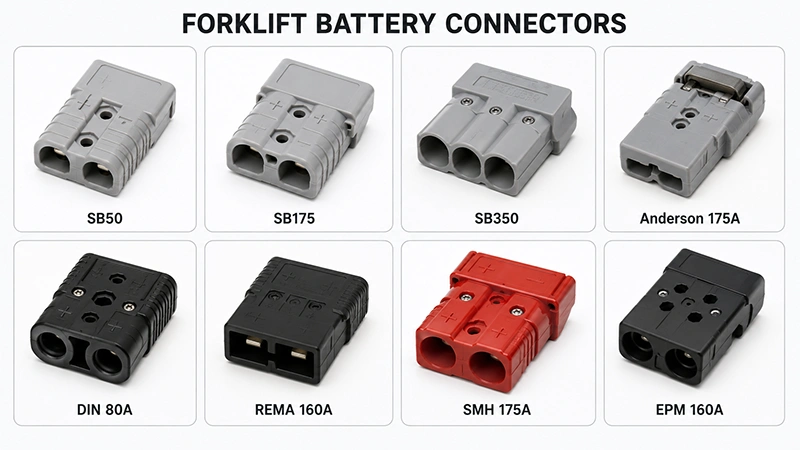
The forklift battery connector is a connection device used for forklift batteries, electrical systems, and power supplies. It mainly consists of an insulating shell, conductive metal terminals, and locking fittings.
- Industrial-grade forklift battery terminal connectors must withstand extreme environments, including bumpy and vibrating operating conditions; physical anti-misoperation measures are required to prevent incorrect charging connections from damaging the equipment.
- Charging bridges, which connect to the lithium battery lead harness on one end and frequently switch between connecting the forklift and charging station on the other, must be able to withstand high currents of hundreds of amperes and have extremely high insertion/removal life.
Knowing Amperage and Voltage Ratings
Choosing the right forklift battery connector specification is the most critical step in mitigating supply chain risks. It is mainly determined by the amperage and voltage. If the wrong one is chosen, it will not be compatible and may even cause downtime or fire.
Selecting the Correct Amperage (50A, 175A, 350A)
The amperage rating determines the maximum current a connector can handle, which is directly related to the forklift’s tonnage, load capacity, and workload:
50A / 80A: Suitable for small material handling equipment: electric pallet jacks, light-duty aerial work platforms.
175A / 160A: Conventional industrial material handling equipment: 1.5-3 ton counterbalance electric forklifts, reach trucks.
350A / 320A: Suitable for heavy-duty industrial environments: >3.5 ton large electric forklifts, heavy-duty handling equipment in ports. Under heavy-load, high-intensity operation, it needs to withstand the large instantaneous starting current.
Voltage and the Color-Coding System
In industrial connectors, voltage (V) identification employs a highly stringent, globally recognized color-coding system. This is not only aesthetically pleasing but also ensures physical safety.
The physical slot structure of connectors for each voltage is completely different, requiring matching colors for mating. Below are the international voltage and color correspondence standards:
| Housing Color | Rated Voltage | Typical Application |
|---|---|---|
|
Yellow |
12V |
Light-duty special equipment, small tractor, system control and start-up |
|
Orange |
18V |
Specialty industrial equipment and some niche battery packs |
|
Gray |
36V |
North American and traditional medium-sized electric forklift mainstream voltage standards |
|
Blue |
48V |
The core specifications of modern, high-efficiency electric forklifts and warehouse reach forklifts |
|
Red |
24V / 80V |
24V is commonly found in small warehouse trucks; 80V is widely used in large-tonnage heavy-duty forklifts in Europe. |
Most Used Forklift Battery Connector Types: Anderson & REMA
Global standards for industrial electric forklifts: Anderson and REMA DIN, representing North America and Europe, and the differences between traditional lead-acid and modern lithium batteries.

Anderson Style Connectors
Anderson forklift battery connectors are primarily used in traditional 24V, 36V, and 48V lead-acid forklifts in North America. Their biggest advantage is their non-polarity and matte design; there’s no distinction between male and female connectors, and terminals of the same amperage can be interlocked, reducing the number of SKUs for OEM brands.
Their flat wiping contacts automatically remove surface-adhered carbides and oxide layers during insertion and removal, extending their lifespan.
REMA Din Connectors
REMA DIN connectors have a strict distinction between male and female connectors, conforming to the European industrial standard DIN 43589-1.
The female connector connects to the vehicle body or charger, while the male connector is installed on the battery pack. It features a dedicated mating handle for easy and quick field insertion and removal.
Another highlight is its multi-channel auxiliary pin configuration, in addition to transmitting high current. This allows the lithium battery to transmit real-time data to the forklift via CAN communication.
Material and Design Requirements for Heavy-Duty Environments
To withstand harsh outdoor industrial environments, a qualified forklift battery terminal connector must pass rigorous industrial testing for both its housing and metal connectors. The following are the standards that distinguish high-performance connectors from low-end imitations:

Housing Material: Polycarbonate vs Plastics
The outer shell is the connector’s first line of defense; it must withstand mechanical impacts such as accidental drops, being run over by wheels, or being pulled forcefully.
Polycarbonate is a high-quality material, molded from highly impact-resistant PC material. It is not prone to becoming brittle and cracking, and possesses the highest UL94 V-0 flame retardant properties and acid corrosion resistance.
Recycled plastic is an inferior material, mixed with ABS or PP plastic. After a few months, it is extremely prone to cracking and ignition.
Contacts Material: Silver-Plated Copper
The conductive metal terminals are the heart of the connector, responsible for handling instantaneous currents of hundreds of amperes, thus determining its safety.
High-end terminal connectors use high-purity red or purple copper contacts with a silver-plated finish. This reduces resistance, minimizes heat generation, and prevents oxidation.
Inferior terminal connectors use brass with a zinc-plated finish, which increases internal resistance and causes rapid heat generation.
Custom Wiring and Cable Assemblies
We have found that many forklift connectors require secondary processing such as wire stripping, crimping, and heat shrink tubing to form a tight connection with high-load cables.
Why Pre-Assembled Wiring Harnesses Save Costs
The advantages of choosing pre-assembled forklift battery cable connectors from the source factory are as follows:
- Reduced labor costs. Overseas labor costs are high; sourcing ready-to-use cable assemblies can increase costs by up to 70%.
- Eliminating the safety hazards of manual crimping. Without specialized hydraulic presses and crimping dies, internal wire cores are easily loosened.
- 100% industrial quality. The factory must have automated integrated wire stripping and crimping machines and pass rigorous factory conductivity tests, withstand voltage tests, and tensile strength tests.
What Else to Look For in a Forklift Battery Terminal Connector
Once the technical parameters and specifications are confirmed, it also needs to meet global compliance requirements. A high-quality forklift battery terminal connector must pass power-on tests and meet the access certification requirements of international authoritative organizations.
Compliance and International Certifications
When selecting a source factory, you need to meet the following three global certifications:
UL certification, confirming that it meets stringent US testing requirements in all aspects, including current, insulation, temperature rise performance, and flame retardancy.
CE certification, complying with the Low Voltage Directive and Machinery Directive, and bearing the CE mark.
RoHS & REACH environmental directives, prohibiting the inclusion of harmful flame retardants such as polybrominated biphenyls (PBBBs), and strictly controlling the content of heavy metals such as lead, cadmium, and mercury, facilitating smooth customs clearance.
Conclusion
Proper forklift battery connectors range from matching rated current and voltage color-coding systems to terminal types. We offer 100% matching connectors to meet your specific needs, and we also provide high-quality forklift batteries for your selection.
FAQs
The biggest advantage of Anderson-style connectors is their complete symmetry at both ends, with no distinction between male and female connectors. They are commonly used in North America, Asia Pacific, and with traditional lead-acid batteries.
REA DIN connectors are commonly used in modern lithium-ion batteries to meet the requirements of fast charging and real-time communication.
The forklift battery connector lockout is not only a technical specification, but also a mandatory requirement to ensure safety and comply with international safety regulations.