
Have you encountered issues like your RV lights constantly flickering? Or your air conditioner issuing a low-pressure alarm shortly after use? Today, we’ll guide you from the perspective of a 12V RV battery manufacturer on how to inspect and extend battery life.
This guide provides a complete testing process, from visual inspection to load testing, giving you a comprehensive understanding of how to scientifically assess the health of your RV battery.
Table of Contents
TogglePreparation: Tools Needed to Test 12V RV Battery
To ensure accurate RV battery testing, you will need the following tools:
1. A digital multimeter: A high-precision digital multimeter capable of reading two decimal places is recommended.
2. A battery load tester: This simulates real-world battery discharge scenarios, allowing you to read the battery’s performance under actual workload.
3. A hydrometer: If your battery is lead-acid, this is essential for measuring the specific gravity of the electrolyte, helping to determine the cell’s health.
4. Safety gear: Such as safety glass and chemical-resistant gloves, to prevent acid leakage.
5. A wire brush or sandpaper: To clean the battery terminals of oxide, acid residue, or rust, ensuring perfect contact of the test probe.
Step 1: The Visual Inspection
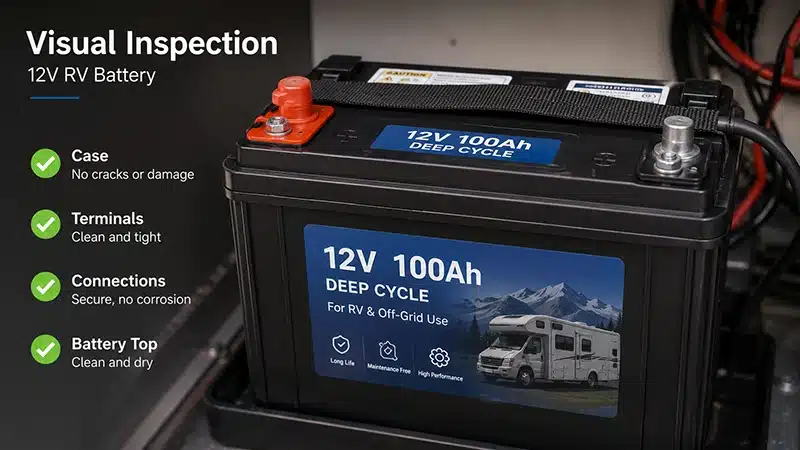
Visually inspect the following:
Corrosion: Check the battery terminals for white powdery crystals. This is a typical product of acid gas leakage and oxidation, which increases resistance and causes a voltage drop.
Physical damage or bulging: Check the battery casing for cracks or deformation. If any are found, they need to be discarded immediately.
Loose wiring: Check that the connections are secure. Loose connections can easily cause electrical sparks during RV travel due to bumps and vibrations.
Step 2: Testing Voltage with a Multimeter

Next, measure the battery’s static voltage using a digital multimeter. The steps are as follows:
Battery resting: Disconnect all loads and let the battery rest for 4 hours.
Set up the external multimeter: Set the range to DC voltage and select 20V.
Connect the probes: Connect the red probe to the positive terminal of the battery and the black probe to the negative terminal. Refer to the voltage and SoC comparison table below:
| Open Circuit Voltage | State of Charge | Battery Status |
|---|---|---|
| > 12.7V | 100% | Full charged |
| 12.4V | 75% | Healthy |
| 12.2V | 50% | Discharged |
| 12V | 25% | Deeply discharged |
Step 4: Testing Specific Gravity
If your battery is a maintainable flooded lead acid battery, measuring the specific gravity of the electrolyte using a hydrometer is the most direct chemical diagnostic method.
Wear protective gear and carefully unscrew the water filler cap on top of the battery.
Insert the hydrometer’s rubber tubing vertically into one of the individual cells, squeezing the rubber bulb to draw in sufficient electrolyte until the internal float is fully afloat.
Read the reading at eye level and record the value. Then squeeze the electrolyte back into the original cell. Perform independent measurements on all six individual cells in sequence.
If the test result is between 1.265 and 1.275, the cell is fully charged and the chemical reaction is good.
If the test result is 1.150 or below, the cell is fully discharged.
If the specific gravity difference between any two cells is greater than 0.050, this indicates that the battery is dead and beyond repair; this is a typical sign of battery failure.
Signs Your 12V RV Battery is Bad
Based on the above physical and electrochemical tests, if your battery exhibits the following symptoms, it means the battery is no longer usable:

Sudden voltage drop under load: the battery initially displays 12.7V, but the voltage immediately drops to 11.5V once you turn on the RV’s microwave; the voltage recovers after the load is turned off. This indicates that the battery has extremely high internal resistance and cannot release effective current.
Inability to fully charge: even after charging for 24 hours, the battery’s open-circuit voltage is only 12V, failing to reach 12.6V.
Odor of rotten eggs: during charging, the battery heats up intensely and releases hydrogen sulfide fumes. This indicates that the electrolyte is undergoing forced electrolysis.
Severe sulfation: lead-acid batteries that have been undercharged for a long time are prone to forming a layer of white sulfuric acid crystals on the surface, hindering chemical reactions.
When to Replace with LiFePO4 Battery?
Many RVs now use lithium iron phosphate (LFP) batteries. As a professional manufacturer, we recommend upgrading at the following times:
If you prioritize deep discharge capability, LFP batteries can achieve 95% DoD, allowing your new battery to hold twice the capacity for the same size and weight.
If you prioritize long lifespan, our premium LiFePO4 battery can easily cycle over 3000 times.
If you prioritize weight reduction, lithium batteries of the same capacity are one-third lighter than lead-acid batteries, effectively reducing the load.
If you prioritize fast charging, LiFePO4 batteries support high-current fast charging with a charging efficiency of over 98%, perfectly matching the RV’s solar charging system.
Conclusion
Regularly checking the health of your 12V RV battery is essential for ensuring a safe and reliable RV trip. The visual inspection, static and load voltage tests described above allow you to easily determine the battery’s true condition. Alternatively, you can contact Hongyitai to customize your RV battery, completely transforming your off-grid RV living experience.
FAQs
Absolutely not. Once you connect it to AC power, the battery voltage you measure with a multimeter will typically be 13.6V - 14.4V, which is not the battery's actual voltage.
A standard 12V lead-acid battery should read 12.6V, while a lithium iron phosphate battery should have an open-circuit voltage of 13.6V.