
Do you know what type of battery your ship uses? AGM batteries have long been the preferred choice for reliable, maintenance-free power in marine applications, but not all marine batteries are AGM. Modern ships are not limited to AGM batteries; LiFePO4 lithium batteries are a good alternative.
Mastering battery technology is not just about focusing on technical details, but also a key strategy for optimizing the supply chain and reducing the total cost of ownership.
Table of Contents
ToggleWhat Types of Marine Batteries Are Used?
Today, we’ll break down three existing mainstream marine battery technologies, each with its own specific structure, performance, and commercial applications.
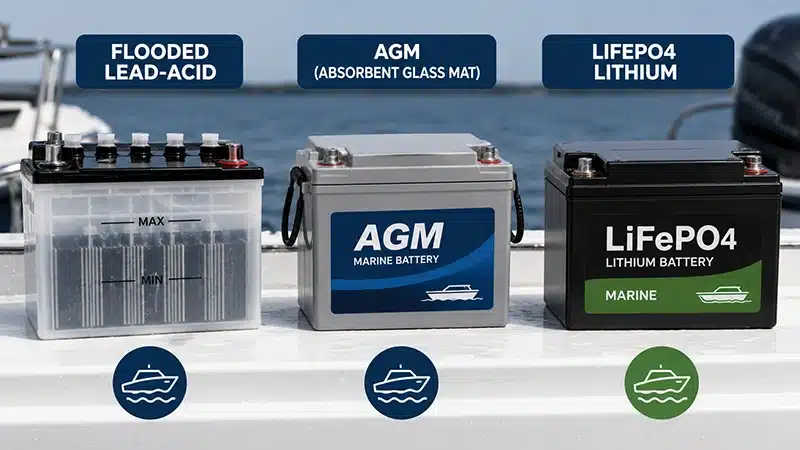
Flooded Lead-Acid Batteries
This is the most traditional battery technology, the cheapest, but it relies on its liquid electrolyte, requiring you to manually add distilled water periodically. This leads to high hidden costs later on, as it carries the risk of acid leakage and can easily release harmful gases in severely bumpy environments.
AGM Batteries
The absorbed glass mat batteries solve the structural defects of traditional flooded batteries. Inside the AGM battery, the acidic electrolyte is completely absorbed by a specialized glass fiber separator sandwiched between lead plates. This design enables true sealing, leak-proof operation, and maintenance-free operation.
For nearly two decades, AGM batteries have been the default standard for mid-to-high-end marine and commercial fleets. They can be installed at any angle, have excellent shock resistance, and provide a stronger starting current. However, they are still inherently limited by the physical limitations of traditional lead-acid chemistry: heavy weight and a depth of discharge of only 50%.
LiFePO4 Lithium Batteries
This is the primary battery type for modern ships, offering significant upgrades in energy density and structural lifespan. It inherently possesses extremely high thermal stability, integrates a BMS protection system, allows for the release of 100% of its rated capacity, and weighs only 70% of lead-acid batteries, directly improving the ship’s range and speed.
Why AGM Batteries Were the Industry Standard for Marine Applications
AGM batteries once dominated the mid-to-high-end marine market, primarily due to the following characteristics:
1. Truly maintenance-free. AGM batteries utilize a weather-composite technology, converting gas into water during charging, achieving a completely sealed environment. This eliminates the need for any electrolyte maintenance, significantly reducing operating and management costs.
2. Superior shock resistance. Traditional battery plates are prone to cracking in the ocean, leading to internal short circuits. AGM batteries, however, tightly wrap and compress the lead plates with a fiberglass diaphragm, resulting in a compact structure that enhances shock resistance.
3. Safe and flexible installation. The electrolyte in AGM batteries is completely absorbed into the fiberglass pad, with no flowing liquid. Even if the vessel tilts, the battery will not leak acid. This allows for flexible installation in various locations on the vessel, freeing up valuable interior space.
4. Instantaneous high-current output. It can release a massive cold-start current in a very short time, starting heavy-duty engines and ensuring smooth, one-button ignition even in 0°C environments.
The Turning Point: AGM vs. LiFePO4 for Marine Applications

Modern ships have increasingly demanding battery requirements, rendering traditional AGM batteries inadequate. Lithium iron phosphate batteries, with their overwhelming technological advantage, are rapidly replacing AGM batteries. Below is a comparison of the core parameters of these two types of batteries:
| Performance Metrics | AGM Marine Battery | LiFePO4 Marine Battery |
|---|---|---|
| Cycle Life @ 80% DOD | 300 - 500 Cycles | 3,500 - 5,000+ Cycles |
| Usable Capacity | 50% | 80% - 100% |
| Weight | 100% | Approx. 30% - 40% |
| Charging Efficiency | 85% | 99% |
| BMS Protection | None | Integrated Smart BMS |
| TCO Over 5-10 Years | Higher | Lower |
A typical 12V 100Ah AGM battery weighs around 30kg, while a LiFePO4 battery of the same capacity typically weighs less than 11kg. Switching to lithium batteries can directly reduce the weight of the entire ship by hundreds of kilograms. This frees up significant cabin space, significantly reduces carbon emissions, and improves the ship’s overall power performance.
Although the initial purchase cost of LiFePO4 is higher than that of AGM, its usable capacity is twice that of AGM and its lifespan is 10 times longer. Over a longer timeframe of 5 to 10 years, you might need to replace 3-4 sets of AGM batteries and incur high labor costs for replacement. A single lithium battery can operate reliably until 2030. Therefore, LiFePO4 batteries are the truly low-cost solution that can help businesses reduce long-term operating costs.
Choose the Right Marine Battery for Your Fleet
AGM batteries are suitable for: batteries whose sole purpose is to deliver a massive instantaneous current to ignite heavy-duty gasoline engines without requiring any deep-cycle discharge. Alternatively, for end-user projects requiring low-frequency backup power systems.
LiFePO4 marine batteries are suitable for: high-frequency deep-cycle energy storage; electrical boxes for modern luxury yachts, RVs, or commercial workboats; and fishing boats equipped with trolley motors. 12V, 24V, or 36V LiFePO4 batteries have long been the dominant force in this market segment.
Conclusion
Clearly, marine batteries are not necessarily AGM batteries. AGM batteries are currently primarily used for engine ignition, while LiFePO4 lithium batteries, with their more than 10 times longer cycle life, ultra-light weight, and near-perfect total cost of ownership (TCO) performance, are taking over the future of modern marine energy storage.
Hongyitai Technology specializes in custom OEM ODM marine lithium battery solutions, using brand-new LFP cells, smart BMS, and IP6 waterproofing, providing you with the perfect direct replacement solution.
FAQs about AGM marine battery
Yes, but you need to pay attention to charging compatibility and ensure that the ship's existing charging system, inverter, or generator is compatible with the lithium battery charging curve.
AGM batteries were indeed better than lithium batteries in the past, but lithium batteries have now broken this monopoly. The former cannot provide a stable power supply for the various electrical systems on ships, and is bulky, so it is now only suitable as a starting battery.
A set of AGM marine batteries has an average lifespan of 3-5 years. High-quality LiFePO4 marine batteries, on the other hand, can operate for more than 10 years (3000 cycles).