
Lithium iron phosphate (LiFePO4) batteries are becoming the leading choice for marine applications, offering lighter weight, longer lifespan, and maintenance-free operation compared to AGM batteries.
However, choosing a LiFePO4 marine battery is not straightforward. It requires considering numerous factors, including specifications, protection features, vibration, humidity, temperature, and charging source; otherwise, safety hazards may arise.
If you are a ship manufacturer or operator, this guide provides a comprehensive overview of commercial marine battery expertise.
Table of Contents
ToggleWhy Switch to LiFePO4 Battery for Marine Use
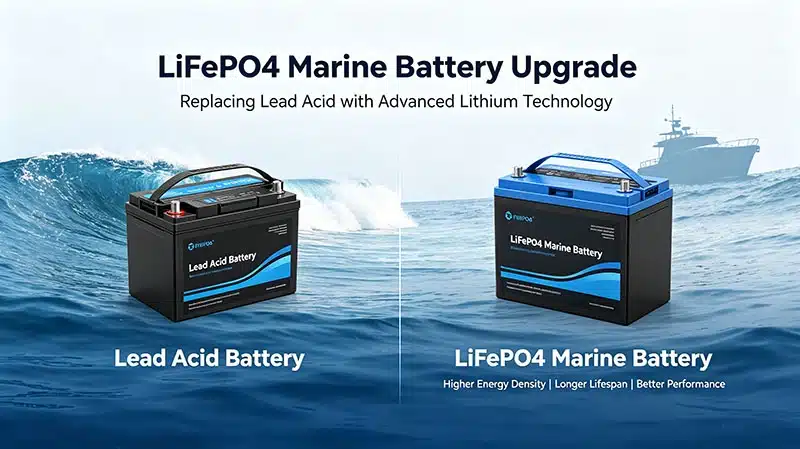
If you’re still using traditional lead-acid batteries to power your boats, now’s the time to consider a new battery – LiFePO4. It avoids the drawbacks of older batteries: heavy weight, short lifespan, slow charging, and frequent maintenance. Here are four reasons to switch to LiFePO4:
1. 50-70% weight reduction. LiFePO4 has 3-4 times the energy density of lead-acid batteries. For the same capacity, a LiFePO4 battery weighs only 30-50% of a lead-acid battery. (Source: DOE Vehicle Technologies Office, Battery Cell Energy Density Trends, 2023).
One of our clients’ 23-foot center-dock fishing boats, originally equipped with two 12V 100Ah AGM batteries (total weight approximately 130kg), was upgraded to one 12V 100Ah LiFePO4 battery (weight approximately 12kg) + one spare LiFePO4 battery. This reduced the stern weight by approximately 100kg, shortened the turnaround time from 4.5 seconds to 3.2 seconds, and saved approximately 8% fuel per hour.
2. Service life extended by 5-10 times. Lead-acid battery cycle life: 300-500 cycles @ 50% DoD; LiFePO4 cycle life: 2000-5000 cycles @ 80% DoD. Furthermore, it is not recommended to discharge the former beyond 50%, while the latter can be discharged up to 95%. This means that one LiFePO4 battery can replace 5-10 lead-acid batteries for their entire lifespan.
3. Charging speed increased by 3-5 times. LFP batteries have an internal resistance only 1/5 to 1/10 that of lead-acid batteries, reducing charging time to as little as one hour. For example, with six round trips per day, each 30 minutes apart, the LiFePO4 battery can be quickly charged to 85% without additional charging time.
4. Virtually zero maintenance. LFP batteries are completely sealed, eliminating the risk of acid leakage. However, you need to check the lead-acid battery level and clean the terminals monthly, requiring 4 hours of manual inspection per month, resulting in annual maintenance costs as high as $1200.
LiFePO4 vs AGM vs Flooded
Below, we will take a 100Ah battery as an example to comprehensively compare these three types of batteries, allowing you to intuitively compare their differences.
| Compare | Flooded Lead-Acid | AGM | LiFePO4 |
|---|---|---|---|
| Weight | 60-70 kg | 55-65 kg | 10-15 kg |
| Available capacity | 50Ah | 50Ah | 80-100Ah |
| Cycle life (@80% DoD) | 300-500 times | 400-600 times | 2000-5000 times |
| Charging time (20%-100%) | 4-5 hours | 4-5 hours | 1.5-2 hours |
| Charging efficiency | 70-85% | 75-85% | 95-98% |
| Self-discharge rate (monthly) | 5-10% | 2-5% | 1-3% |
Usable capacity: Lead-acid batteries can only be safely used for about 50Ah, while LiFePO4 can be used for 80-100Ah.
Total cost (5 years): Lead-acid batteries may need to be replaced 2-3 times, while one LiFePO4 battery is sufficient. Including wear and tear and maintenance costs, the price difference of LiFePO4 can be recovered within 2-3 years.
Understanding LiFePO4 Battery Specs for Boats
When you receive a LiFePO4 battery specification sheet, please carefully review the following technical parameters, explained one by one:
- Capacity: Represents the amount of electricity the battery can store. It determines how long a trolley motor can operate. You need to pay attention to the actual usable capacity, and be wary of low-priced batteries with inflated capacity claims.
- Charge Rate: Indicates the ratio of the battery’s charge/discharge rate to its capacity. A 1C rate fully charges in 1 hour, while a 0.5C rate takes 2 hours. Generally, trolley motors require 0.2C-0.5C, and motors require 5C-10C to start, ensuring sufficient peak current to start the motor.
- Cycle Life: The number of complete charge/discharge cycles the battery can perform before reaching 80% capacity. LiFePO4 batteries have a cycle life of 3000 cycles. If it undergoes one complete cycle per day, it can operate for 5.5 years.
- Depth of Discharge: The percentage of the battery’s total capacity that is released. LFP batteries are recommended to be discharged 80-100%. For example, with a 100Ah battery, you can release at least 80Ah of capacity.
- Voltage: The battery’s potential difference. The lithium iron phosphate battery has a nominal voltage of 3.2V and an operating voltage range of 2.5V – 3.25V. The corresponding charger should be configured according to this voltage.
- BMS: This is the core safety component of the entire battery pack. Below, we will introduce each protection function in detail.
- Operating temperature: -20°C ~ 60°C. You need to adhere to the recommended operating temperature range. If you live in a cold region, it is recommended to add a self-heating function.
Built-in BMS: The Heart of Marine LiFePO4 Batteries

The battery management system (BMS) is like the brain of the battery pack, a standard safety component, and typically features the following five protection functions:
1. Overcharge Protection: When the battery voltage reaches its upper limit, the BMS cuts off the charging circuit, preventing further charging and avoiding overheating or even thermal runaway.
2. Over-discharge Protection: When the battery voltage drops to its lower limit, the BMS cuts off the discharge circuit, stopping discharge. An Australian customer left his yacht on shore for an extended period without charging; after a year, the yacht wouldn’t start because the battery had been over-discharged. Our engineers, after evaluation, recommended charging it with a 0V charger to restore the battery to its normal voltage.
3. Overcurrent Protection: This is the battery’s maximum charging and discharging current. Excessive current can cause abnormal battery heating and accelerate battery aging. You need to pay close attention to the continuous discharge current, peak current, and duration.
4. Temperature Protection: The BMS has a built-in temperature sensor that stops charging and discharging when the temperature exceeds the safe range (-20 – 60°C). You need to check if it supports charging below 0°C and if it supports self-heating.
5. Balancing Function: Ensures consistent voltage across all cells within the battery pack. Passive balancing dissipates heat through resistors, offering low cost and a simple structure; active balancing transfers energy from high-voltage cells to low-voltage cells, offering high efficiency but at a higher price.
For marine environments, the BMS is also recommended to include vibration, moisture protection, and communication protocol capabilities. When evaluating suppliers, you can ask the following questions:
Is the BMS developed in-house or outsourced?
What brand of MOSFETs is used?
Does the BMS have a conformal coating for moisture protection?
What is the BMS failure rate?
Does it have Bluetooth/communication functionality?
More features in a BMS are not necessarily better, nor does having a BMS guarantee the battery will never have problems. Rigorous selection and commissioning are required to ensure the battery pack operates within safe limits.
How to Choose the Right LiFePO4 Battery Size & Capacity for Your Boat
To avoid running out of power mid-trip with an undersized battery, or wasting money on an oversized battery, you can calculate the required battery capacity using the following method:
Step 1: Determine the battery’s purpose. Is it a starting battery, a deep discharge battery, or a dual-purpose battery?
Step 2: Calculate the total power consumption. Below is a summary of onboard equipment power consumption for your reference. You can also check the power rating on the equipment label. Considering the number of days of sailing and the planned depth of discharge, you can refer to this formula to obtain the required battery capacity:
| Devices | Ampere | Daily usage time (hours) | Daily power consumption (Ah) |
|---|---|---|---|
| Trolley motor | 30A | 4 hours | 120 Ah |
| Fish finder/GPS | 2A | 6 hours | 12 Ah |
| Navigation lights | 1.5A | 2 hours | 3 Ah |
| Live water tank pump | 4A | 3 hours | 12 Ah |
| Audio | 3A | 4 hours | 12 Ah |
| Bulch pump (automatic) | 2A | 0.5 Ah | 1 Ah |
| Total | 160 Ah |
Required battery capacity (Ah) = total daily power consumption (Ah/day) × number of sailing days ÷ planned depth of discharge (DoD)
Step 3: Consider additional runtime. Power consumption increases as equipment ages; we recommend adding a 20-30% safety margin.
Step 4: Determine the system voltage. Most small boats use a 12V system. If your trolley motor (1000W or higher) is high enough, you can consider increasing the voltage in series.
Quickly view recommended capacities for different boat types:
| Boat type | Typical electrical equipment | Recommended LiFePO4 capacity | System voltage |
|---|---|---|---|
| Small fishing boat (14-16 feet) | 30-40lb | 50-100Ah | 12V |
| Medium-sized fishing boat (17-20 feet) | 50-70lb | 100-200Ah | 12V |
| Large fishing boat (21-25 feet) | 80-110lb | 200-300Ah | 24V |
| Multi-purpose recreational boat (20-24 feet) | Trolley motor, sound system, lights | 150-250Ah | 12V/24V |
| Commercial fishing vessels | High-intensity use | 500-1000Ah+ | 24V/48V |
Real-World Applications – Fishing Boats, Yachts, Trolling Motors
Operating a fleet of five fishing boats in Florida, providing daily guided fishing tours, they found that their existing 48V 100Ah lead-acid batteries couldn’t power their trolley motors for a full day (8-9 hours), and the frequent battery replacements resulted in high total cost of ownership, preventing them from scheduling multiple trips a day.
After a comprehensive evaluation, we recommended LiFePO4 deep-cycle battery packs, which extended battery life by 150%, allowing for 10+ hours of operation per day. The fast-charging capability enabled the fleet to add sunset tours, helping them increase revenue by 20%, ultimately earning positive feedback from the client.
Certifications & Safety for Commercial Marine

Marine battery certification helps you clear customs quickly and provides access to your target market.
UN38.3 & MSDS Transport Safety Certification: Mandatory; without this certification, batteries cannot be safely delivered to their destination country.
CE Certification: Mandatory; required for batteries to enter the EU.
IEC 62619 Certification: Suitable for industrial equipment, stationary energy storage, and marine applications.
In addition, you can request IP waterproof rating and salt spray test reports from suppliers to ensure the safe completion of your marine projects.
How to Charge & Store Properly LiFePO4 Battery
He must use a charger specifically designed for LiFePO4 batteries, not a lead-acid charger, because the charging voltage is incompatible and the charging algorithms are different. Choose a suitable charger based on the voltage and current range of your battery pack; additionally, ensure the charging ambient temperature is between 0°C and 55°C, as low-temperature charging can easily cause lithium deposition, damaging the battery.
If the boat has seasonal downtime (such as in winter), you need to store the batteries properly. Based on our experience, storing at 60% SOC for one year results in a LiFePO4 capacity loss of approximately 2-3%; while storing at 100% SOC for one year can result in a loss of 10-15%. Before reactivating after storage, please check the following:
- Inspect appearance: for bulges, cracks, and corrosion.
- Inspect terminals: for oxidation and looseness.
- Measure voltage: should be between 12.8V and 13.2V.
- Fully charge: Use a LiFePO4 charger to fully charge to 14.4V-14.6V.
- Pre-installation test: Test discharge on shore with a known load.
How to Custom OEM ODM Marine LFP Battery at Hongyitai
Hongyitai provides standard batteries, as well as OEM and ODM marine battery services. We design sheet metal housings, BMS (BMS communication protocol), power display, and connection methods based on your technical specifications. Once our design is approved, we quickly provide sample services.
Next, you arrange sample testing: functional (charge/discharge, BMS protection, communication) testing, and environmental (vibration) testing. After the sample tests are passed, we confirm the bulk order. Our typical lead time is 2-3 weeks.
FAQs about Marine LiFePO4 Batteries
In most cases it is possible, but you need to check things like size, alternator compatibility, and low-temperature charging.
Standard deep-cycle LiFePO4 is generally not suitable for starting engines, but dedicated starter or dual-purpose starter types can.
We have no MOQ limit, so contact us now to get started without any pressure.