
Modern RVs rely heavily on air conditioning, microwaves, and other electronic devices. For RV manufacturers, purchasing solar panels, controllers, and inverters separately not only leads to time-consuming installations and complex wiring, but also risks incompatibility.
Therefore, we recommend adopting complete RV solar systems to improve your assembly efficiency, reduce after-sales costs, and quickly bring your RV commercial projects to fruition.
Table of Contents
ToggleCore Components of an Integrated RV Solar Panel Kit
A high-efficiency integrated RV solar panel kit with battery and inverter is not simply a matter of assembling components; it requires rigorous electrical engineering design. The following are four core components.
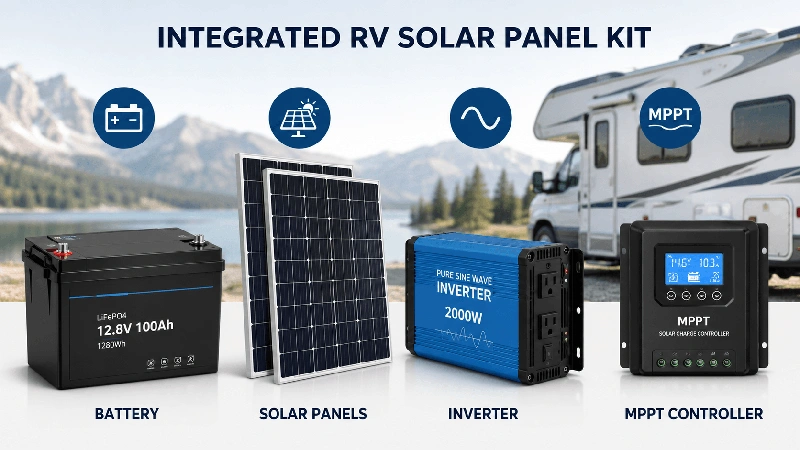
High-Efficiency Solar Panels
Monocrystalline silicon solar panels are the energy source for the entire system. We typically use PERC or TOPCon cell technology, which improves efficiency by 22% compared to ordinary single-cell solar panels. Combined with an anode aluminum alloy frame and high-transmittance, low-iron hardened glass, it can withstand wind pressure of 2400 Pa and snow pressure of 5400 Pa, thus perfectly resisting road bumps and extreme weather.
Premium LiFePO4 Battery Pack with Smart BMS
Lithium-ion batteries are the core and most expensive component, primarily lithium iron phosphate batteries, which have replaced traditional lead-acid batteries. They boast a long cycle life of over 6000 cycles, high safety, high thermal stability, and are less prone to fire.
They feature a built-in industrial-grade battery management system that provides real-time protection against overcharging, over-discharging, short circuits, and temperature fluctuations. They also have active balancing capabilities and support multiple protocols for interface with inverters.
Pure Sine Wave Inverter
The RV system uses a pure sine wave inverter to convert the battery’s DC power into the required AC power for appliances such as air conditioners and microwave ovens. It supports twice the rated power output, easily handling the high starting current requirements of large in-vehicle appliances.
Unlike a modified sine wave inverter, it outputs a more stable current with a total harmonic distortion (THD) of less than 3%, providing greater peace of mind.
MPPT Charge Controller
To maximize the efficiency of converting solar energy into electricity, you need to install a Maximum Power Point Tracking (MPPT) controller, which boasts a maximum tracking efficiency of up to 99%, 20% higher than traditional PWM controllers.
It also conforms to the three-stage charging logic (bulk, boost, float) of LiFePO4 batteries, effectively extending battery life in the RV.
How to Scale From 12V to 48V RV Solar Systems
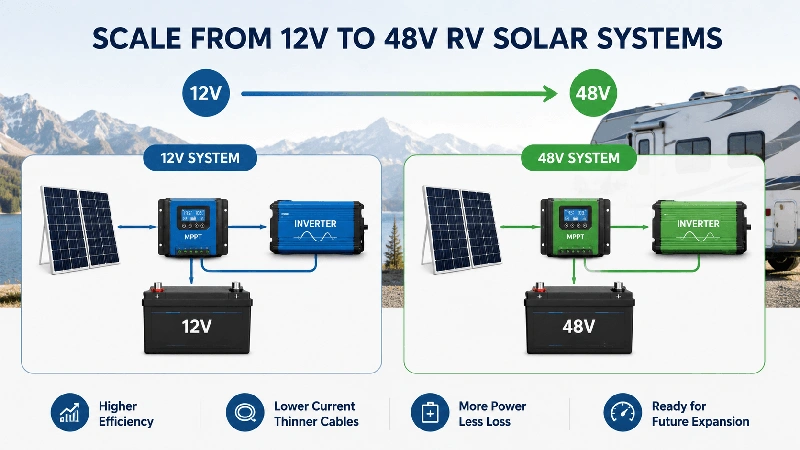
For a long time, 12V systems dominated the RV industry, but with the increase in high-power appliances, you need to boost the voltage to 24V, or even 48V.
48V systems are mainly used in all-electric, luxury Class C motorhomes, and large Class-A motorhomes. Once you install 48V high voltage, the current drops by a factor of four, allowing you to use thinner, lighter wires, while also significantly reducing heat dissipation (according to P=I*I*R), resulting in a qualitative leap for the entire RV solar kit.
When upgrading from a 12V to a 48V system, you need to purchase a high-voltage MPPT controller, connect solar panels in series and parallel to boost the voltage to 100V-150V, and also configure a DC-DC step-down module to convert 48V to 12V to power 12V instruments, lights, water pumps, etc.
How to Choose the Right Battery & Inverter Capacity
The specifications of the battery and inverter determine the overall cost and user experience. Too low a configuration can easily lead to overload or capacity anxiety, while too high a configuration will increase the vehicle’s weight.
Step 1: evaluating inverter capacity based on peak load
The rated power of a pure sine wave inverter must be sufficient to cover the total power of all electrical appliances that may be turned on simultaneously in the vehicle, with a 20% safety margin. A 2000W inverter is suitable for compact campervans, a 3000W inverter is suitable for Class B and Class C vehicles, and a 5000W inverter is suitable for luxury all-electric motorhomes.
Step 2: Calculating LiFePO4 battery capacity for autonomy
For a basic light off-road system, primarily consisting of a DC 12V refrigerator, fan, water pump, LED lighting, and mobile phone charging, we recommend a 12V 200Ah (2.56 kWh) LiFePO4 battery paired with a 2000W inverter.
For mainstream Class B campervans and standard Class C motorhomes, requiring 4-6 hours of parking air conditioning and microwave operation, we recommend a 12V 400Ah or 24V 200Ah (5.12 kWh) LiFePO4 battery paired with a 3000W inverter.
For large Class C motorhomes, 4×4 off-road heavy trucks, and luxury commercial vehicles, which completely eliminate the need for gas and allow air conditioning to run continuously for 10-12 hours or more, we recommend a 48V 100Ah-200Ah (approximately 5.12 kWh-10.24 kWh+) LiFePO4 battery paired with a 3000W-5000W inverter.
Benefits of Sourcing Complete RV Solar Panel Kits
When you purchase integrated kits, you enjoy a unified factory warranty and direct contact with a single supplier, significantly improving communication efficiency. They all feature plug-and-play interface designs, high compatibility between components, and simple operation, reducing your assembly costs.
Partner with a Reliable RV Solar Kit Wholesale Manufacturer (OEM/ODM)
The factory with strong R&D capabilities provides the technological backbone for your RV commercial project. View our RV batteries.
1. We help you customize your logo on solar panels, battery casings, and inverters, enhancing your brand recognition. Learn global top RV battery manufacturers.
2. Our smart BMS supports CANbus and RS485, compatible with all inverter brands, allowing seamless integration with your central control screen for real-time power, voltage, and temperature monitoring across multiple screens.
3. Our Hongyitai factory implements the ISO9001 quality management system. Every integrated RV solar panel kit undergoes rigorous factory testing and meets CE, UN38.3, and MSDS certification requirements.
4. Our MOQ is only 10 sets, allowing you to test the market at minimal cost and launch your project without pressure.
FAQs About Complete RV Solar Systems
First, calculate the total daily power consumption: Multiply the rated power of all electrical equipment in the vehicle by the estimated daily usage time. A 12V car refrigerator, a 1000W air conditioner operating for 4 hours, and LEDs and a water pump (200Wh) would require 5.64 kWh per day.
Matching the LiFePO4 Battery Capacity: To maintain independent range for one day in complete darkness, considering the recommended depth of discharge (DOD) of 90% for lithium batteries, the required battery capacity is 5640Wh / 0.9 = 6266 Wh. If using a 24V system, a 24V 260Ah battery pack is needed.
Calculating the power of monocrystalline solar panels: Assuming an average of 4 hours of effective sunshine per day in the target market, and considering a 75% overall conversion efficiency loss for the solar system, the required total power of the solar panels is: 5640Wh / 4h / 0.75 = 1880W.
Yes, in the commercial RV sector, LiFePO4 outperforms traditional lead-acid batteries in terms of safety, thermal stability at 600℃, and return on investment. Furthermore, our batteries all use sheet metal casings for physical protection.
Fully supported. This is one of our core technological barriers as an integrated manufacturing and trading source factory. Our complete integrated RV solar panel kit with battery and inverter completely eliminates the traditional piecemeal state of disparate components.