
RV battery selection involves more than just capacity; it requires a comprehensive evaluation of size, weight distribution, cost, and range. The BCI standard specifies the physical dimensions and performance of RV batteries, with groups 24, 27, and 31 being the most commonly used. However, many people easily confuse these groups. Today, we’ll delve into their differences in size, performance, and long-term ROI to help you choose the most suitable battery for your needs.
Table of Contents
ToggleWhy BCI Group Sizing Matters in RV OEM & Fleet Management
Battery standardization is an important way to control costs and ensure quality. The Battery Council International has developed the BCI group sizing, the main functions of which are as follows:
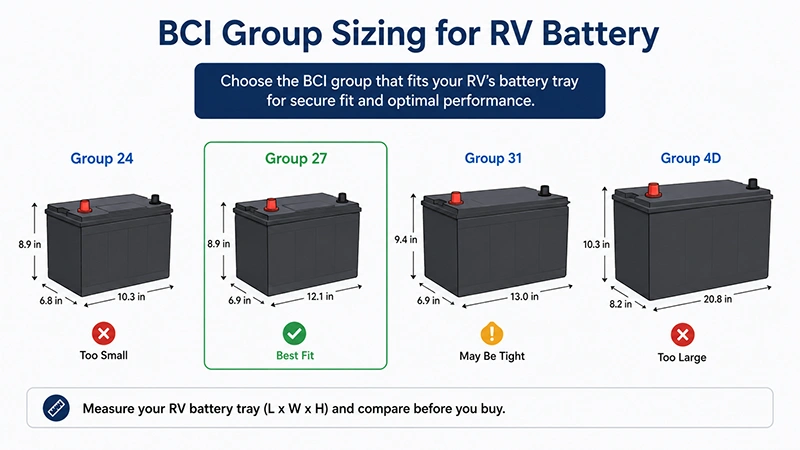
Engineering design compatibility. Even minor dimensional changes can lead to high costs for mold and structural modifications. Groups 24, 37, and 31 specify length, width, height dimensions, and terminal polarity.
Seamless supply chain integration. Whether you source batteries directly from OEMs or from overseas aftermarket outlets, they offer 100% worry-free replacement.
Reduced RV residual value. Standard BCI-sized batteries have high compatibility in used RVs, ensuring high residual value for the entire vehicle when the fleet is decommissioned.
Therefore, choosing Group 24, 27, or 31 is ostensibly about choosing the battery, but in reality, it’s about choosing the vehicle’s electrical platform architecture.
BCI Group 24, 27, and 31 Battery Dimensions & Specifications
The core difference between groups 24, 27, and 31 is the proportional increase in physical size and capacity. Below is a technical comparison of these three core BCI groups under industry standards.
| BCI Group Size | Maximum Dimensions (L × W × H) | Average Weight | Typical Capacity Range | Reserve Capacity |
|---|---|---|---|---|
| Group 24 | 10.25" × 6.81" × 8.88" | ~43 - 50 lbs | 70 - 85 Ah | 130 - 150 Mins |
| Group 27 | 12.06" × 6.81" × 8.88" | ~53 - 60 lbs | 85 - 100 Ah | 160 - 180 Mins |
| Group 31 | 13.00" × 6.81" × 9.44" | ~60 - 75 lbs | 100 - 130 Ah | 190 - 220 Mins |
Group 24 Battery Specs
Group 24 is the lightest (50 lbs) and most compact size, mainly used for entry-level travel trailers. It has the lowest procurement cost and can effectively lower the entry barrier, but its maximum capacity is only 85 Ah, which cannot support high-power operation.
Group 27 Battery Specs
Group 27 represents the industry’s golden balance; its width and height are identical to Group 24, but its length is increased by 2 inches, and its capacity is increased by 20%. It’s suitable for Class B and Class C motorhomes, cheaper than Group 31, and has a larger capacity than Group 24. However, its continuous power supply capability is insufficient for high power consumption requirements.
Group 31 Battery Specs
Group 31 is a high-capacity battery for modern motorhomes, measuring 13 inches in length and half an inch higher than the aforementioned models. Suitable for Class A motorhomes and luxury SUVs, it boasts a capacity of up to 130Ah, perfectly matching 2000W-3000W pure sine wave inverters. Due to its bulkiness, it requires a robust battery compartment structure.
How to Upgrade from Group 24 to Group 27 or 31 Batteries
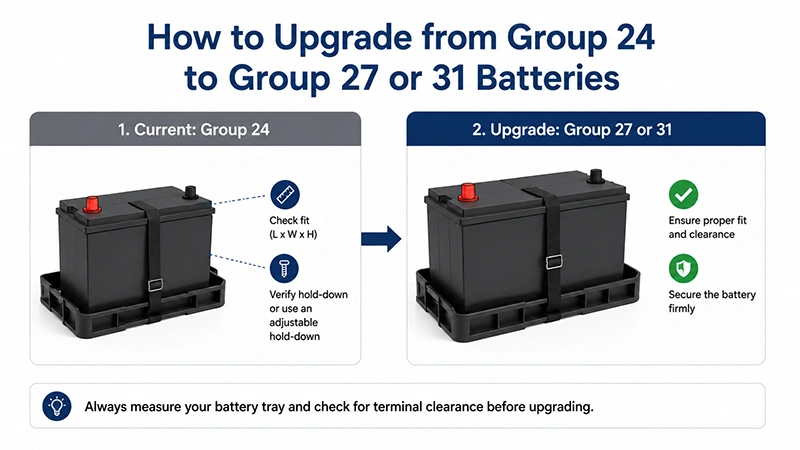
To better meet the power needs of RVs, we’ve noticed many people upgrading from Group 24 systems to Group 27 and 31 batteries. We recommend evaluating the following three aspects:
1. Physical dimensions and engineering modifications. Because the length and height of Group 27 and 31 batteries are increased, your existing J-hook fixing bolts and top strips may be insufficient. You’ll need to replace them with heavy-duty adjustable braided straps or longer stainless steel strips to prevent physical impacts caused by insecure mounting on bumpy roads.
2. Upgrade wiring harnesses and current. One of our Australian customers upgraded to Group 31 batteries and replaced all his wiring harnesses with 1.0 AWG wires. The circuit breaker was also adjusted according to his maximum load current and wire length.
3. Reset charging algorithms and charger parameters. Since the recommended charging current for Group 24 batteries is 20A, while Group 31 batteries can easily be charged at 50A, we recommend adjusting the charger output power to avoid excessive charging time.
Engineering & Design Considerations for RV Manufacturers
The choice of BCI battery in RV design directly determines the vehicle’s market potential. We recommend considering the following three aspects:
Battery compartment design. Even if you design for Group 24 batteries, you should at least reserve space for Group 31 batteries to facilitate upgrades in the aftermarket.
Mechanical structural strength. To accommodate customers upgrading to Group 31 batteries, you can add extra reinforcing ribs to the tray structure to meet higher vibration resistance standards.
Vehicle weight distribution. Before upgrading, you need to consider incorporating the actual weight of the added battery into the vehicle’s center of gravity and axle dynamic balance.
Conclusion
There is no absolute superiority or inferiority among Group 24, Group 27, and Group 31 batteries; the choice depends on matching your project goals, technology, and budget.
The Group 24 battery is suitable for the entry-level RV market, focusing on economy, lightweight design, and standard campground power. The Group 27 battery is suitable for mid-sized RVs (Class B/C) or large rental fleets. The Group 31 is ideal for high-end luxury, heavy-duty off-road, or long-term off-grid use. We offer a full range of group 24/27/31 lithium iron phosphate (LiFePO4) battery options for your selection.
FAQs
The battery pack capacity of a standard motorhome depends on your location and power needs. Groups 24 and 27 are used to maintain the normal operation of the onboard refrigerator, water pump, and basic lighting. Group 31 is suitable for motorhomes that are free from grid connections.
Absolutely not. It is strictly forbidden to mix batteries from different BCI groups (group 24 and group 31) in series or parallel.
Without physical structural modifications, this is virtually impossible. The physical dimensions of the group 31 battery are significantly larger than those of the group 24 battery.