
From smart rings to medical-grade monitoring devices, battery life is a core parameter. End users will ask you how many days the device will last and how long do wearable lithium battery last. Today, from the perspective of lithium battery manufacturers, we will delve into the key technical factors affecting the lifespan of wearable lithium batteries and how to extend battery lifespan.
Table of Contents
ToggleWearable Device Battery Lifespan: Cycle Life vs. Calendar Life
The lifespan of lithium batteries for wearable devices is determined by two factors: charge/discharge cycles and calendar life (natural aging time). Both factors jointly determine the battery’s usable duration.
- Cycle Life: It refers to the battery’s lifespan before its capacity drops to 80% of its initial state. One charge/discharge cycle is defined as 0%-100%. Our polymer batteries have a lifespan of at least 500 cycles. With prolonged shallow charging and discharging (20%-80%), it can be extended to 800 cycles.
- Calendar Life: Under prolonged periods of inactivity, the battery’s natural degradation time is 2-3 years. This is primarily affected by ambient temperature and over-discharge.
For high-end wearable devices, we recommend considering low-resistance cells to reduce self-discharge rate and minimize heat generation during cycling, effectively extending battery life.
What Factors Affect the Lifespan of Lithium Batteries in Wearable Devices?
The lifespan of lithium batteries in wearable devices is affected by many factors: temperature, charging habits, and usage patterns, all of which accelerate battery chemical aging.

1. Cut-off voltage and energy density. To meet the compact battery compartment space, many factories use high-voltage batteries to increase energy density, but prolonged use of excessively high voltage accelerates electrolyte decomposition.
2. Charge/discharge rate. Wearable devices often use fast charging to shorten charging time, but high-current charging can lead to lithium dendrite formation and may also pose a risk of battery swelling.
3. Heat buildup. Due to the small size and close fit of wearable devices, heat dissipation is limited. The heat generated during charging cannot dissipate quickly enough, accelerating battery chemical degradation.
How to Extend the Lifespan of Lithium-ion Batteries in Wearable Devices?
As a professional battery manufacturer in China, we recommend that wearable brands consider the following optimization methods during the product development stage to balance battery capacity and long-term reliability:
Optimize Charging Protocol

Don’t blindly aim for a full charge of 100%. We can reasonably set the charging cutoff voltage to around 4.1V, rather than striving for a full charge at 4.2V. You can also encourage consumers to start charging from 20% battery level, rather than always charging from 0%.
Include the original charger with the wearable device; avoid using high-power functions (playing games, watching videos) while charging to prevent overheating and accelerated SEI film growth in the battery.
Partial Discharge
The deeper a battery discharges (<10%), the greater the internal chemical reactions. In wearable device circuit design, you can set up warnings to guide end-users to charge when the battery has about 20% remaining, rather than waiting until it shuts down at 0%. This control of DoD is one of the most effective ways to extend lithium battery lifespan.
Thermal Management

Optimizing PCBA layout is crucial. Within the extremely small space of a wearable device, the battery should be kept as far away as possible from heat sources such as the processor (CPU). You can use highly thermally conductive materials or leave gaps around the battery to allow internal heat to dissipate quickly, reducing battery chemical degradation.
Regular Inspection & Maintenance
The battery lifespan of wearable devices is determined not only by consumers but also by warehouse management.
1. For wearable batteries stored long-term, it is recommended to check the voltage every 3 months to ensure the battery is not depleted. Once the critical voltage is exceeded, the battery may enter a deep discharge state due to self-discharge. If any abnormality is found, please understand to charge to 3.85V.
2. Charge to activate the battery. If the wearable device has been stored on the shelf for more than a year, it is recommended to perform a complete charge-discharge cycle. This activates the electrolyte and recalibrates the fuel gauge accuracy of the BMS, preventing users from receiving products with abnormalities and reducing unnecessary after-sales work.
3. Visual and physical inspection. Before assembly or shipping, the battery must be inspected for slight swelling or leakage. In the extremely small sealed space of a wearable device, even an increase in thickness of 0.1mm can cause it to rupture the casing.
Wearable Device Battery Safety Standards
Wearable device battery safety standards: China’s mandatory national standard GB 31241-2022 ensures that lithium-ion batteries will not catch fire or explode under normal use and misuse conditions, applicable to devices such as smartwatches and fitness trackers.
IEC 62133-2: A globally recognized safety standard. It covers stringent tests including compression, thermal shock, overcharging, and external short circuits, meeting basic regulatory requirements for devices such as fitness trackers.
UN38.3: Mandatory requirements for air and sea transport. This requires batteries to remain stable under pressure changes, severe vibrations, and high/low temperature cycling during transport.
UL1642: A threshold for the North American market. Complies with mandatory requirements of retailers such as Amazon.
KC (Korea): A necessary certification for entering the Korean market.
PSE (Japan): Required by Japan’s Electrical Appliance and Material Safety Law.
CE/RoHS (Europe): Certification for environmental protection and basic safety in the European market.
Our lithium batteries manufactured by Hongyitai meet the regulatory requirements of various countries. You can view our certification reports.
How to Choose the Right Battery for Your Wearables
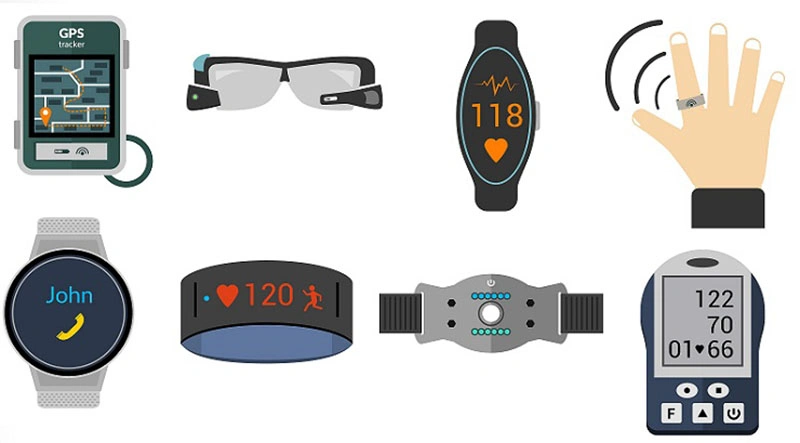
When selecting a suitable battery for wearable devices, please assess and inform us of their power consumption, maximum size, and operating environment to ensure reliability and reasonable pricing.
Battery Type: For low-power IoT devices (such as sensors), choose disposable lithium batteries; for high-frequency wearable devices, choose lithium polymer batteries; for long standby devices, choose lithium iron phosphate batteries.
Voltage (primarily 3.7V) and Capacity: (Battery capacity should meet daily power consumption needs, ensuring at least 2 days of battery life). Calculation formula: Capacity ≥ Daily power consumption (mAh) × Number of days × 1.5 safety factor.
| Battery Type | Energy Density | Cycles | Typical Uses |
|---|---|---|---|
| Lipo Battery | High | 500+ | Wearables, Smart Devices |
| LFP Battery | Medium | 2000+ | Medical |
| Disposable Battery | High | NA | Low Power Monitoring |
We at Hongyitai specialize in manufacturing lithium polymer batteries to meet the needs of various wearable devices. View our 3.7V lithium polymer battery in details.
FAQs About Wearable Battery
We recommend maintaining the battery charge at 3.8V - 3.85V (approximately 40-60% SoC) and storing it in a cool, dry place at 20°C - 25°C.
Advantages: Saves time, charging to 80% in 10-30 minutes, improving user experience.
Disadvantages: Frequent high-current charging can accelerate lithium dendrite formation, which can shorten battery life.
This depends on battery capacity and system power management. A 100mAh smart band can last 5-7 days with a well-optimized system (PMIC).