
The weight of a forklift battery is crucial to operational safety, vehicle balance, and work efficiency. Many of our customers, when upgrading from lead-acid batteries to lithium-ion batteries, overlook the counterweight principle. If the battery is too light, the forklift’s power may be too great, posing a risk of tipping over.
Today, we’ll discuss the ideal weight of a forklift battery and how to find the most suitable battery weight for you.
Table of Contents
ToggleWhy is weight so important for forklifts?
Unlike lightweight vehicles, forklifts require sufficient weight, adhering to the following weight distribution principles:
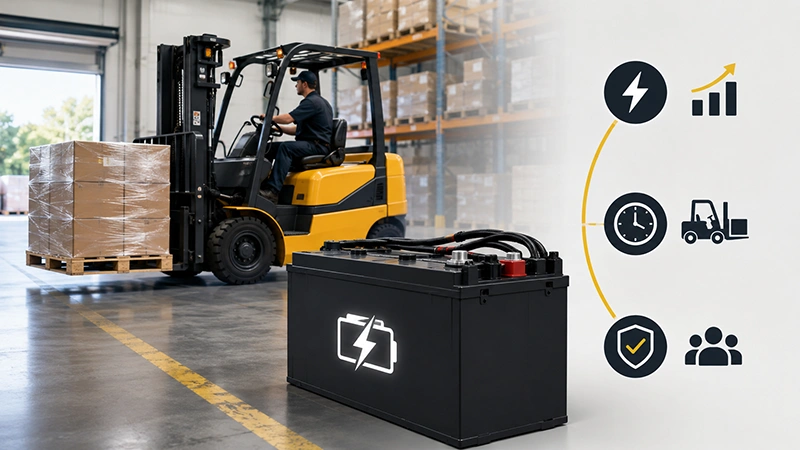
- Physical balance and gravity center. The load on the front wheels of a forklift is the cargo, while the load on the rear wheels is the battery. When a forklift lifts a heavy load, the gravity center of the entire vehicle shifts forward. If the battery weight is insufficient, the downward grip is weak, causing the rear wheels to lift off the ground, potentially leading to a forward tilt and tipping over.
- Meeting the minimum service weight. Every forklift has a data plate specifying the required weight for that model; this is a mandatory safety indicator to meet OSHA CE industrial safety compliance standards.
- Traction and driving stability. Battery weight also ensures sufficient traction for the rear wheels, especially on wet or slippery surfaces. The heavier battery helps to compact the load and prevent slippage.
Therefore, you must not only look at voltage and capacity; battery weight directly determines operational safety.
Recommended battery weights by forklift types
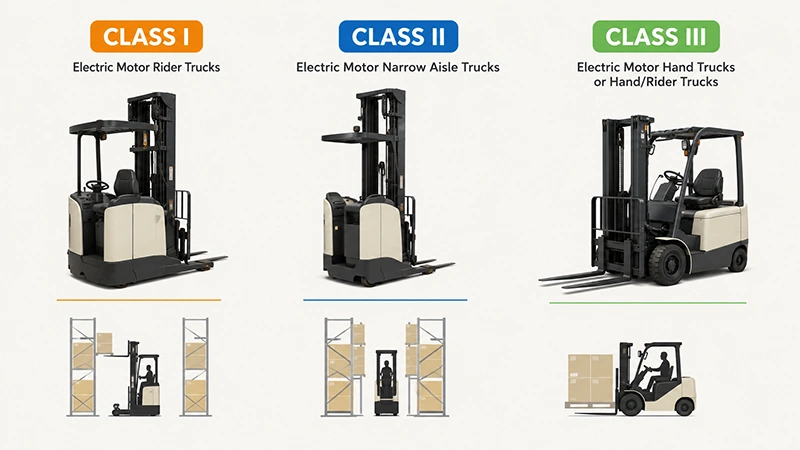
Different types of forklifts have significantly different battery weight requirements. Based on the ITA forklift classification, we have compiled the typical weight ranges for standard lead-acid batteries and lithium iron phosphate batteries as follows:
| Forklift Class | Typical Battery Voltage | Average Weight Range (lbs/kg) |
|---|---|---|
| Class I | 36V / 48V / 80V | 2,000 – 4,000 lbs (900 – 1800 kg) |
| Class II | 24V / 36V | 1,000 – 2,500 lbs (450 – 1100 kg) |
| Class III | 24V | 400 – 1,000 lbs (180 – 450 kg) |
Class I electric motor rider trucks
Class I counterbalance forklifts (three-wheeled and four-wheeled ride-on models) have the most stringent battery weight requirements, relying entirely on the rear-mounted battery as a counterweight to lift loads weighing several tons in front. Recommended battery weights are between 2000 and 4000 pounds (900 to 1800 kg), and they must meet the minimum service weight on all 48V or 80V high-voltage systems.
Class II & III narrow aisle & pallet jacks
Class II (reach trucks, order pickers) and Class III (electric pallet jacks, walkie-talkies) vehicles have significantly lighter batteries.
The former typically use 24V or 36V systems, with batteries weighing approximately 1,000 to 2,500 pounds. While they do require counterweights for balanced design.
The latter are smaller and often used for water transport, with a recommended battery weight of 400 to 1,000 pounds. They do not require high-altitude lifting, have lower additional battery weight requirements, and offer significant weight savings.
Lithium battery vs lead acid,which is best?
Lead-acid and lithium-ion batteries are the most commonly used forklift batteries. Below is a comparison of the two in different aspects:
- Energy density and weight: Lead-acid batteries are very heavy due to their lead content, making them a good counterweight option. Lithium-ion batteries have high energy density, are suitable for embedding in sheet metal casings, and can meet both high performance requirements and 100% of the minimum service weight requirements for forklifts.
- Maintenance costs: Lead-acid batteries require regular water replenishment, equalization charging, and acid mist cleaning; lithium-ion batteries require zero maintenance and have a cycle life 2-3 times longer than lead-acid batteries.
If you have a limited budget and low usage frequency, we recommend traditional lead-acid batteries; if your warehouse requires high-intensity operations and high efficiency, custom lithium-ion batteries are an excellent choice.
Key factors to check before buying
To ensure your forklift battery is the perfect fit in terms of weight and size, please check the following four indicators:
1. Forklift nameplate. Each forklift has a metal tray next to the operator’s seat; you need to ensure it meets the minimum battery weight approval requirement.
2. Battery compartment physical dimensions. Different forklift brands (Toyota, Hyster, Linde) have specific dimensions for their battery compartment’s length, width, and height. Your new battery needs to fit perfectly.
3. Rated voltage and capacity. Standard voltages are 12V, 24V, 36V, 48V, and 80V. Higher capacity means more cells and a heavier battery.
4. Charging and lifting amenities. If you are switching to lithium batteries, you only need to charge them as needed.
Conclusion
The weight of the forklift battery directly determines operational safety and mechanical balance. You need to meet the minimum service weight requirements of the forklift data pallet.
Lithium batteries, with their advantages of zero maintenance, long lifespan, and fast charging, are rapidly replacing traditional lead-acid batteries. Hongyitai, a professional power battery manufacturer with 10 years of experience, customizes 12V, 24V, 36V, 48V, and 80V forklift battery solutions tailored to the specific needs of global forklift brands.
FAQs about forklift battery weight
The forklift battery has a minimum service weight and a maximum weight limit. If it exceeds this limit, it may exceed the vehicle's load capacity, damaging core components and posing a braking hazard.
The forklift battery has a minimum service weight and a maximum weight limit. If it exceeds this limit, it may exceed the vehicle's load capacity, damaging core components and posing a braking hazard.
Yes, lithium batteries weigh only 40% of lead-acid batteries. To match the counterweight of forklifts, it is recommended that the battery be embedded in a specific steel shell to meet the original manufacturer's safety standards.