
Marine battery voltage is more than just a number; it relates to the entire system’s design, cost, and energy efficiency. Currently, the mainstream voltage systems are 12V, 24V, 36V, and 48V. Today, we’ll take you through a deep dive into the classification of voltage platforms, application scenarios, and voltage curves, allowing you to choose the optimal marine voltage system.
Table of Contents
ToggleMarine Battery Voltage Classification & Applications
The marine battery voltage directly determines the compatibility of the entire vessel’s power system and equipment. Based on the needs of the electrical equipment, we can roughly divide them into 12V, 24V, 36V, 48V, 72V, and 96V voltages. See below for the cell combination methods and applications of different voltage platforms to help you quickly select and customize your battery.

12V Marine Battery: Starting Power & Small Vessel Electronics
The 12V marine battery is the basic and most widely used voltage platform. It consists of four 3.2V LiFePO4 battery cells connected in series, with a nominal voltage of 12.8V. It is mainly used for starting conventional internal combustion engines, marine electronics, and small trolling motors (<55 lbs). This is the battery we produce the most and is also the entry-level model for many marine brands.
24V Marine Battery: Mid-Sized Trolling Motors & Marine HVACs
The 24V marine battery is suitable for medium-sized vessels and commercial fishing boats. It consists of eight 3.2V lithium iron phosphate cells connected in series, with a nominal voltage of 25.6V. It is commonly used in medium-sized trolling motors (70-80 lbs thrust equipment), DC air conditioning systems (HVAC), and high-power anchor winches. Compared to a 12V system, the 24V system draws half the current for the same power output. This allows you to reduce wire diameter, lowering overall cable costs and heat generation on the vessel.
36V Marine Battery: Heavy-Duty Trolling Motors for Deep-Sea Fishing
The 36V marine battery is designed for high-end deep-sea fishing and professional racing boats. It consists of 12 3.2V lithium iron phosphate cells connected in series, with a nominal voltage of 38.4V, suitable for 100-110 lbs high-thrust trolling motors. However, if you connect three 12V batteries in series, the weight exceeds 100kg. We’ve found that many customers prefer a single 36V LiFePO4 battery for the lightest possible weight.
48V / 72V / 96V Marine Battery: High-Voltage Electric Propulsion Systems
There is an increasing demand for marine batteries with voltages of 48V or even higher. These batteries consist of 16 lithium iron phosphate cells connected in series, with a nominal voltage of 51.2V, and are suitable for pure electric propulsion systems, large yachts, and hybrid vessels. This is also the type of battery we customize most frequently for OEMs and ODMs, primarily because of their highest energy conversion efficiency.
Lead-Acid vs. LiFePO4: Understanding the Voltage Curves & Efficiency
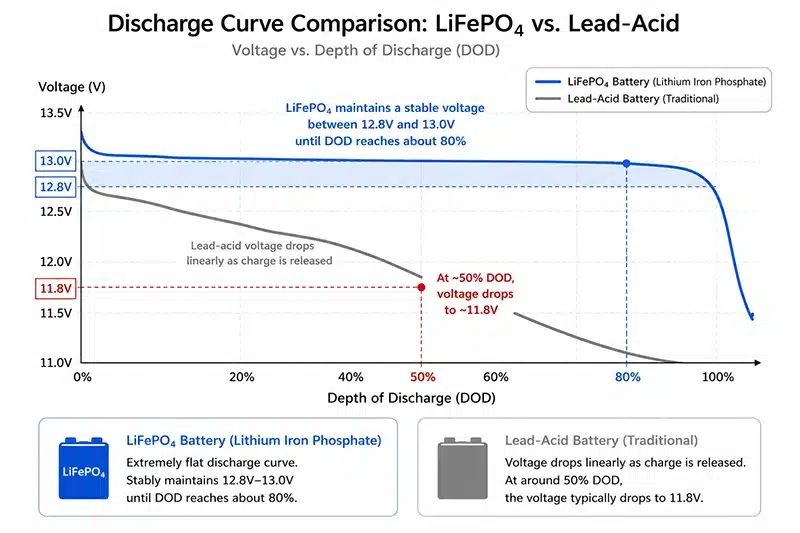
Modern ships are transitioning towards digitalization and electrification. When evaluating battery voltage systems, it’s crucial to assess the voltage stability and energy conversion efficiency of different batteries. Traditional lead-acid batteries and LFP batteries exhibit significant differences in their discharge curves, directly impacting the end-vehicle’s range and the overall ROI of the system.
1. Stable voltage platform vs. linear decline: Lithium iron phosphate (LFP) batteries possess an extremely flat discharge curve, maintaining a stable voltage between 12.8V and 13.0V for an extended period until the depth of discharge (DOD) reaches 80%. Traditional lead-acid batteries, on the other hand, experience a linear voltage decline as charge is released. By around 50% discharge, the voltage typically has dropped to 11.8V, potentially leading to unexpected restarts due to low-voltage protection or insufficient thrust.
2. Depth of discharge (DOD) and effective capacity conversion rate: Lead-acid batteries have a significantly inflated nominal capacity, with a maximum depth of discharge of only 50%. Lithium iron phosphate (LiFePO4) batteries support 80%-100% depth of discharge while maintaining a cycle life of over 3000-5000 cycles. LiFePO4’s charge-discharge efficiency is as high as 95%-98%, while lead-acid batteries only achieve 75%-80% (the remaining energy is lost as heat).
3. The impact of weight and energy density on ship draft. Battery weight and volume directly affect a ship’s fuel consumption and speed. LiFePO4’s energy density is typically about three times that of lead-acid batteries. Providing the same nominal capacity (24V 100Ah), lithium batteries weigh only 1/3 of lead-acid batteries. Many of our traditional lead-acid battery customers who upgrade to lithium batteries do not change the battery compartment size but increase their energy storage capacity by 2-3 times.
Why Modern Marine Systems are Upgrading to 48V
This is not a simple technological upgrade, but a pursuit of higher ROI and lightweight design.
In electrical design, the power (loss) formula determines the system architecture: P = I * V. Under the premise of outputting the same power, increasing the system voltage from 12V to 48V by four times will directly reduce the current of the entire system to 1/4 of the original.
Heat loss in a circuit is proportional to the square of the current. Reducing the current to 1/4 will drastically reduce heat loss to 1/16 of the original.
The power requirements of modern luxury yachts and commercial workboats are vastly different. Traditional 12V batteries are already struggling. If you directly use a 48V system and add a high-efficiency 48V to 12V DC-DC converter, it can perfectly match 12V instruments and LED lights. This is our company’s flagship high-voltage power, low-voltage control solution.
Choosing the Right Voltage System for Your Fleet
If you are designing a new boat brand, you can evaluate the voltage system from the following two dimensions:
1. Define specific power requirements. 12V batteries are suitable for small fishing boats and kayaks, powering the engine and dashboard. 24V & 36V batteries are suitable for mid-to-high-end deep-sea fishing and lure boats, helping your brand attract professional customers. 48V batteries are suitable for modern luxury yachts and hybrid propulsion systems.
2. Salt spray and vibration resistance. Regardless of the voltage you choose, the battery must have an IP65 waterproof and dustproof design; international market access certifications: UN38.3, MSDS, CE, UL1973.
Conclusion
By understanding the above marine battery voltage classification, discharge curves, and high-voltage trends, you can select the optimal marine lithium battery based on your vessel’s range, the power consumption of your ship’s electrical equipment, communication protocols, and waterproofing requirements.
Hongyitai has developed and designed over 20 different marine batteries with varying voltages and capacities. Each battery is highly praised by our customers, and we are happy to help you upgrade comprehensively, providing you with the best battery option. Click on our marine battery pack for more information.
FAQs about how many volts in a marine battery
12V battery charging voltage: 14.6V, 24V battery charging voltage: 29.2V, 48V battery charging voltage: 58.4V.
Traditional Lead-Acid batteries are considered low-voltage when their voltage drops to 11.8V; if forcibly discharged to 10.5V, the battery will be severely damaged. LiFePO4 lithium batteries have a fully discharged voltage of 10.0V.