
In industrial design, lithium polymer battery connectors often serve as an invisible line of defense between high-performance products and catastrophic field failures. They represent the ultimate bottleneck in thermal and mechanical performance, directly impacting contact resistance, shock-absorbing locking, and signal integrity.
To help you select the optimal interface for your power system, today we’ll provide an in-depth analysis of 10 of the most commonly used lipo battery connectors from a professional engineering perspective, ensuring the stable and safe operation of your products in complex environments.
Table of Contents
ToggleThe Critical Role of Connectors in Industrial Power
Connectors act as the bridge between polymer battery-connected PCBAs. Each connector has internal contact resistance; high current flow generates significant heat, and exceeding the rated current can lead to thermal runaway.
Insufficient insertion/extraction force or a lack of locking mechanisms in the connectors can cause loosening, resulting in intermittent power outages. Furthermore, connectors need to transmit data via SMBus or I2C protocols; gold-plated pins effectively prevent oxidation, ensuring reliable communication between the BMS and host equipment.
Top 10 Connectors by Application
Depending on your PCB space dimensions and maximum discharge current, you will need to select the correct connector to avoid thermal failure.
Ultra-Compact & Signal Level (<2A)
1. JST SH 1.0
Manufacturer:JST
Pitch:1.00mm (0.039”)
Current Rating:1.0A AC/DC (AWG #28)
Mating Wires:AWG #28 to #32
Application:Ultra-thin wearables, smart sensors.
Key Advantage:Minimal footprint for space-constrained PCBs.
Study further link: https://www.jst-mfg.com/product/pdf/eng/eSH.pdf

2. Molex PicoBlade (51021 Series)
Manufacturer:Molex
Pitch: 1.25mm (0.049”)
Current Rating: 1.0A AC/DC
Mating Wires: AWG #26 to #32
Application: Precision medical handhelds, high-density electronics.
Study further link: https://www.molex.com/content/dam/molex/molex-dot-com/en_us/pdf/datasheets/987651-3691.pdf?inline

Mid-Range Power & Data (2A - 10A)
3. JST PH 2.00mm
Manufacturer:JST
Pitch: 2.00mm (0.079”)
Current Rating: 2.0A AC/DC
Mating Wires: AWG #24 to #32
Application: Internal battery-to-board connections.
Key Advantage: High reliability and low cost for mass production.
Learn further link: https://www.jst-mfg.com/product/pdf/eng/ePH.pdf

4. Molex Micro-Fit 3.00mm
Manufacturer: Molex
Picth: 3.00mm (0.118”)
Current Rating: Up to 8.5A
Mating Wires: AWG #20 to #30
Application: Industrial Robotics, Automation.
Key Advantage: Features a Positive Lock for high-vibration security.
Learn further link: https://www.molex.com/content/dam/molex/molex-dot-com/en_us/pdf/datasheets/987650-5984.pdf?inline

5. JST VH 3.96mm
Manufacturer: JST
Pitch: 3.96mm (0.156”)
Current Rating: 10.0A AC/DC
Mating Wires: AWG #16 to #22
Application: Power supplies, signal transmission in machinery.
Key Advantage: Large pitch prevents arcing in high-voltage packs.
Learn further link: https://www.jst-mfg.com/product/pdf/eng/eVH.pdf

High-Current & Harsh Environments (>30A)
6. Amass XT30U
Manufacturer:Amass
Type: Plug/Socket
Current Rating: 15A to 30A
Mating Wires: AWG #16 to #20
Application: Compact UAVs, high-power IoT.
Key Advantage: Gold-plated brass pins for low resistance.

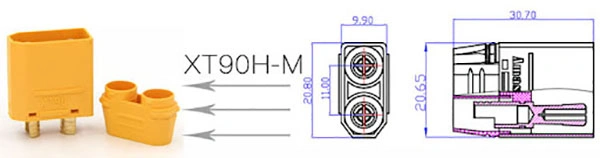
7. Amass XT60H (With Sheath)
Manufacturer: Amass
Type: Plug/Socket
Current Rating: 30A to 60A
Mating Wires: AWG #12 to #14
Application: AGVs, electric tools.
Key Advantage: Protective rear sheath; no heat shrink needed.

8. Amass XT90-S
Manufacturer: Amass
Feature: Integrated Anti-Spark resistance
Current Rating: 45A to 90A
Mating Wires: AWG #8 to #10
Application: 12S+ lipo battery systems, energy storage.
Key Advantage: Prevents inrush current sparks during connection.
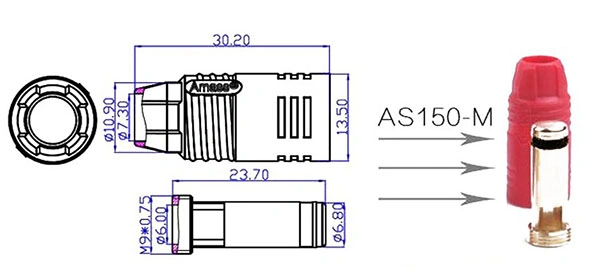
9. Amass AS150
Manufacturer: Amass
Diameter: 7.0mm Large Banana Plug
Current Rating: 70A to 150A
Mating Wires: AWG #6 to #8
Application: Heavy-duty Agricultural Drones.
Key Advantage: Massive surface area for heat dissipation.
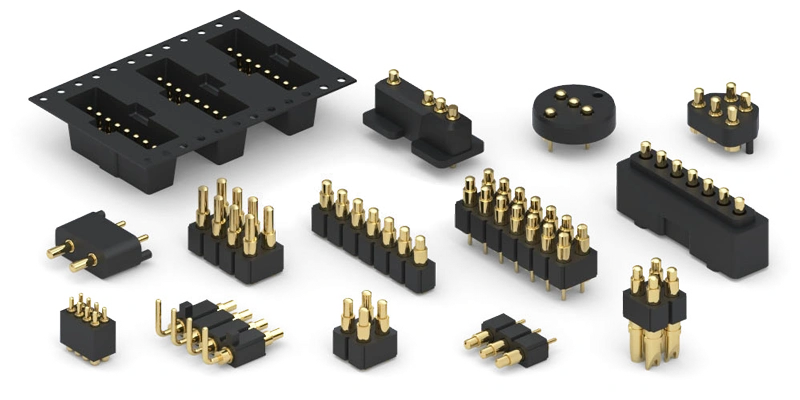
10. Pogo Pin
Type: Custom Charging Contact
Current Rating: 2A to 20A
Mating Cycles: 10,000+ cycles
Application: Docking Stations, automatic charging.
Key Advantage: High Durability for repeated robotic docking.
The Connector Engineering Comparison
We have compiled a comprehensive comparison of the above 10 mainstream lipo battery connectors, covering dimensions such as current capacity, spacing, and industrial reliability.
| Connector Series | Pitch (mm) | Rated Current (Continuous) | Peak Current (10s) | Locking Mech | Typical Application |
|---|---|---|---|---|---|
| JST SH | 1.00 | 1.0A | 1.5A | Friction | Wearables / IoT |
| Molex PicoBlade | 1.25 | 1.0A | 1.5A | Friction | Medical Handhelds |
| JST PH | 2.00 | 2.0A | 3.0A | Friction | General Consumer |
| Molex Micro-Fit | 3.00 | 8.5A | 10.5A | Positive Lock | Industrial / Robotics |
| JST VH | 3.96 | 10.0A | 13.5A | Friction | Home Appliances |
| Amass XT30U | N/A | 15A | 30A | Friction | Small UAVs |
| Amass XT60H | N/A | 30A | 60A | Friction | AGVs / Tools |
| Amass XT90-S | N/A | 45A | 90A | Anti-Spark | High-Voltage Packs |
| Amass AS150 | N/A | 70A | 150A | Friction | Agricultural Drones |
| Pogo Pin | Custom | 2A - 20A | Custom | Magnetic/Auto | Auto-Charging Docks |
Remark: The rated current in the table is based on standard ambient temperature. For high-temperature environments, we recommend allowing a 20% derating headroom.
Pitch and Voltage: Connectors with larger pitches, such as JST VH, provide better insulation resistance and are less prone to arcing in high-voltage battery packs.
Your Connector Checklist Before Sourcing
Purchasing Lipo battery connectors involves more than just finding a part number; you need to consider these 5 key factors:
- Flammability rating & material housing: Ensure the housing meets the UL94-V0 flame retardant rating. Inferior plastics are prone to melting during thermal runaway.
- Gold-plating thickness: If you are using it in industrial products, a gold plating thickness of at least 3µm or 5µm is recommended to prevent wear after repeated mating and unmating, which can lead to oxidation and high contact resistance.
- Terminal crimping quality: You need to check the supplier’s crimping height and pull-out test reports. Many equipment failures in the field are mainly due to voltage drops and wire detachment caused by poor crimping.
- Wire gauge (AWG) compatibility: You need to ensure that the wire gauge (AWG) matches both the connector’s maximum value and the system’s peak current. Only thin wires can cause overheating.
- Environmental compliance: For global export, it must comply with RoHS 3.0 and REACH environmental directives.
Conclusion
Choosing the right lithium polymer battery connector is crucial, as it relates to current, mating life, and environmental resilience. Hongyitai is more than just a lithium battery manufacturer; we offer complete battery solutions.
If you’re unsure which connector is right for your product, contact us for assistance with custom harness assembly and high-performance lipo batteries.