
The 18650 battery specifications — encompassing its voltage, capacity, internal resistance, and charge/discharge rates—ultimately determine its intended application. Approaching this from the perspective of battery manufacturing, we guide you through an in-depth exploration of all these parameters and their significance, helping you select the cell and battery pack best suited to your needs.
Table of Contents
Toggle18650 Battery Key Technical Specifications
The core parameters of an 18650 battery are the key to ensuring a perfect match with your hardware system. These specifications directly determine the endurance, performance, and safety of your end device.
Physical Dimensions
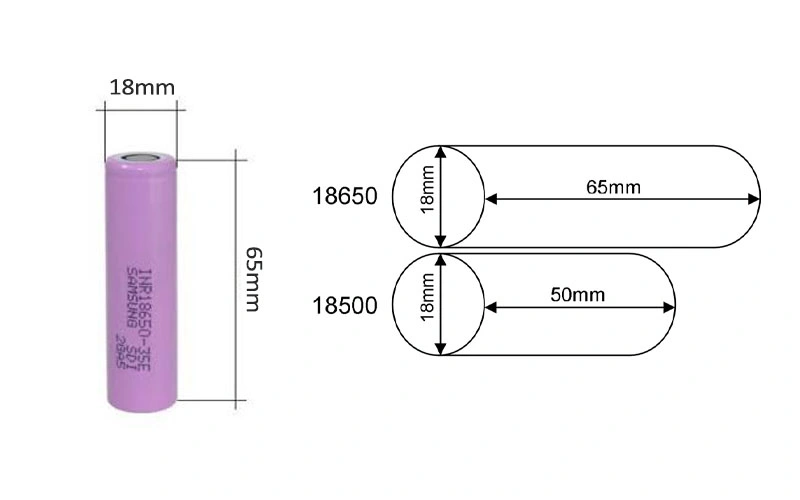
The 18650 battery is named after its physical dimensions: a diameter of 18 mm and a length of 65 mm, with the final “0” indicating a cylindrical shape. The standard 18650 cells commonly encountered feature a “flat top,” which facilitates subsequent series and parallel configurations.
Voltage & Capacity
Most 18650 Li-ion cells have a nominal voltage of 3.6V or 3.7V, with an operating voltage range of 3V to 4.2V.
The capacity of 18650 cells typically ranges from 1800mAh to 3500mAh.
Discharge Rates
18650 batteries are categorized into capacity-type and power-type cells. The former typically features a 1C discharge rate and is suitable for applications requiring long battery life, while the latter supports discharge rates of 3C, 5C, or 10C and is specifically designed for power tools or high-power equipment.
Internal Resistance
Internal Resistance (IR) is a key metric for assessing the quality and consistency of battery cells. High-quality, A-grade power cells typically have an internal resistance of less than 20 mΩ; the lower the internal resistance, the less heat is generated. Click to view the specifications for the Samsung 18650 INR18650-25R 2500mAh battery.
Safety & Certification Standards for 18650 Battery
Listed below are the mandatory safety certifications for 18650 batteries. Hongyitai provides the corresponding certifications and reports for all its 18650 battery packs, ensuring that your products meet all regulatory requirements for sale.

- UN38.3: This serves as the “passport” for batteries entering the global market. It comprises eight rigorous tests, including altitude simulation, thermal cycling, vibration, shock, and external short-circuiting.
- IEC 62133: An international standard specifically for portable sealed secondary batteries. It is a fundamental, mandatory certification required for market entry into regions such as the European Union, Japan, and South Korea.
- UL 1642: The most authoritative safety standard for lithium batteries in the United States. It is an essential certification for listing products on major retail platforms such as Walmart and Amazon.
How to Select 18650 Cells for Battery Packs
Assembling individual battery cells into a battery pack is a complex systems engineering process. Our engineering team will select the most suitable 18650 cells based on your battery compartment size, discharge current, and thermal management requirements. Get started to custom 18650 battery pack.
For example, if your device requires a continuous current of 20A, we can consider a 4P battery pack, selecting cells that support a continuous discharge current of 5A. Next, we will handle the 18650 cell matching, protection board design, and integration. You can learn how to find the best custom battery manufacturer here.
18650 Battery Life Cycle & Storage Guide
The cycle life refers to the number of complete charge-discharge cycles a battery can undergo before its capacity drops to 80% of its initial value. Factors affecting this life include charge/discharge frequency, depth of charge/discharge, and operating temperature. 18650 batteries typically have a cycle life of 500-800 cycles.
The optimal storage environment for 18650 batteries is 15°C to 25°C, with a relative humidity of 45%-75%. The optimal state of charge (SOC) for long-term storage is 30%-50%. For long-term storage, it is recommended to charge the battery to 50% SOC every 3 months.
FAQs
Flat-top battery: With a flat surface, it facilitates automatic spot welding and is commonly used in 18650 battery packs.
Button-top battery: Primarily used in flashlights, medical instruments, and other devices where individual batteries are directly replaceable; the protruding end is generally the positive terminal.
No, 18650 batteries have two chemical systems: LFP and NMC, with different cutoff voltages of 3V and 2.75V. We recommend that you use cells from the same batch and brand, and match all cells before connecting to the BMS.
You can check if your cells are A-grade using the following steps:
1. Consistency Test: Measure the internal resistance and open circuit voltage (OCV). A-grade cells have extremely small resistance differences, with an internal resistance difference within 2mΩ.
2. Visual Inspection: Check if the PVC heat shrink tubing is flat and free of scratches, and whether there are any signs of soldering on the positive and negative terminals.
3. Capacity Test: Use a professional Battery Testing System to test at the standard discharge rate. The actual capacity should be greater than the Minimum Capacity stated in the datasheet.