
The modern material handling industry has increasingly stringent environmental requirements, leading to the gradual market obsolescence of traditional lead-acid batteries due to their slow charging, cumbersome maintenance, and short lifespan.
LiFePO4 forklift batteries are now the preferred solution for electric forklifts. So how should you customize a battery to match your forklift? This article provides comprehensive guidance on selecting the right LFP forklift battery, considering technology, cost, and suppliers, helping you improve your total costs of ownership.
Table of Contents
ToggleWhy the Material Handling Industry is Switching to LiFePO4
In 24/7 multi-shift operations, traditional lead-acid batteries sometimes cannot meet the demands of efficient warehouse operations. Therefore, many warehouse centers and brands are switching to Lifepo4 forklift batteries, which offer the following benefits:
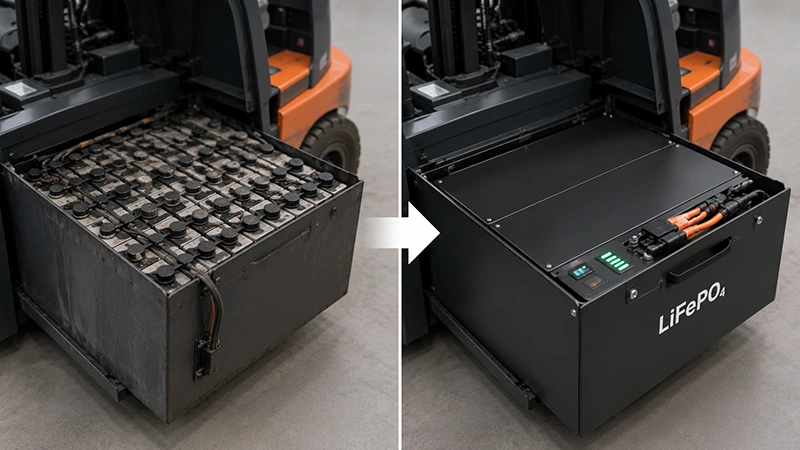
- Resolves battery anxiety during high-intensity operations. Lead-acid batteries charge slowly (8 hours to charge, 8 hours to cool), requiring 1-2 spare batteries for the same amount of warehouse handling. However, the LiFePO4 chemistry system supports fast charging, allowing you to charge during lunch breaks, tea breaks, or short shifts, reducing the need for spare batteries.
- Eliminates maintenance costs. Lead-acid batteries require water addition and acid removal; conversely, Lifepo4 batteries do not contain heavy metals and do not release gases during charging.
LiFePO4 Forklift Batteries Benefits
Switching to lithium iron phosphate (LFP) batteries is not just an equipment upgrade, but also an investment that boosts profits.
- Extremely high energy conversion efficiency. Lead-acid batteries have an energy conversion rate of only 70%, while LFP batteries boast an efficiency of up to 95%, saving you a significant amount on electricity bills each year.
- Longer cycle life. Lead-acid batteries have a lifespan of only 1200 cycles (3-4 years), while LFP batteries have a lifespan of 3500 cycles (10 years), equivalent to 2-3 lead-acid batteries.
- Stable output power. With lead-acid batteries, forklifts become increasingly slow and struggle to climb hills when the battery is low. LFP batteries, on the other hand, have a flat discharge curve, providing continuous full-power output and maintaining efficient operation at full load.
- Environmentally friendly. LFP batteries do not contain toxic heavy metals such as lead, cadmium, and mercury, and there is no risk of acid leakage, making them environmentally friendly.
Key Technical Specs to Check Before Purchasing LFP Forklift Batteries

To avoid purchasing inferior batteries, please carefully check the following key parameters:
1. Voltage and capacity matching. The new battery must be compatible with the original vehicle’s electrical system. You can choose a larger capacity battery for longer runtime. Here are the main voltage levels for forklifts:
- 24V / 36V: Suitable for pallet trucks and small storage equipment.
- 48V: Suitable for counterbalance forklifts and reach trucks.
- 80V / 96V: Suitable for high-intensity handling, container stackers, and large outdoor forklifts.
2. The battery’s brain: BMS
Industrial forklift battery BMS typically has the following functions:
CAN-bus Communication Protocol: Enables seamless data communication with the onboard controllers, dashboards, and external smart chargers of well-known forklift brands such as Toyota, Linde, and Hyster, displaying the true SOC.
Multiple Protection Mechanisms: Includes overcharge protection, over-discharge protection, overcurrent protection, and thermal protection.
Active/Passive Balancing: Autonomously adjusts the voltage of each cell to prevent premature battery pack failure due to the “weakest link” effect.
3. Cell grade and manufacturing process
Preferably select Grade-A cells to ensure high consistency in voltage, capacity, and internal resistance, guaranteeing a battery pack lifespan of up to 3500 cycles. Also, be wary of Grade B or recycled cells; many low-cost battery packs use these cells, eliminating potential safety hazards in advance.
4. Charge and discharge rates
Forklifts require extremely high instantaneous current when lifting heavy loads or climbing hills. Therefore, during procurement, it is essential to confirm that the battery’s continuous discharge current and peak discharge current meet the forklift motor’s requirements.
High-quality LiFePO4 forklift batteries should support fast charging from 0.5C to 1C, allowing for a full charge in one hour.
5. Enclosure protection rating and counterweight requirements
IP Rating: Forklift operating environments are complex; enclosure protection should at least reach IP54 or IP65.
Counterweight: Lithium batteries are relatively lightweight and require an additional metal box to match the original vehicle’s counterweight to ensure the forklift’s center of gravity stability and physical safety when fully loaded and lifted.
How to Choose a Reliable LiFePO4 Forklift Battery Manufacturer
Upgrading your batteries to lithium iron phosphate (LFP) is a significant investment. To ensure you receive high-quality LFP batteries, please rigorously evaluate the following aspects:
1. Customization and OEM/ODM capabilities: Forklift brands differ in battery size, wiring harness interfaces, and counterweights. Factories need to quickly and accurately customize battery solutions and steel casings based on your specific needs.
Upgrading your forklift fleet to LFP technology is a substantial asset investment. However, the booming market has also spawned a large number of suppliers with varying quality. For B2B buyers, choosing the wrong partner can lead to frequent downtime, compatibility issues, and even serious safety hazards.
2. Technological accumulation: You can inquire whether the factory has OEM experience with well-known forklift or national brands, how many years of experience in the material handling industry, and how long it takes to prototype forklift batteries.
3. Compliance certifications: It’s best to obtain a series of international certifications such as UN38.3, MSDS, and IEC62619. This will allow for faster customs clearance and market entry.
4. Comprehensive after-sales and warranty services. When the BMS malfunctions, can the factory perform remote technical upgrades? How can the factory implement a 5-year warranty?
5. Cell traceability. Is the factory willing to provide certification documents for Class-A cells, such as inkjet printing, purchase contracts, and cycle data?
Conclusion
LiFePO4 forklift batteries are an unstoppable force in green new energy and intelligent transformation, revolutionizing opportunity charging capabilities, offering zero maintenance, a cycle life of over 5 years, and the potential to cut operating costs by 40%.
Hongyitai has manufactured 10 different forklift lithium batteries, all with cells sourced from top-tier Chinese manufacturers and equipped with BMS communication technology. Click on our quality forklift battery for more information.
FAQs
No, lead-acid batteries use a three-stage charging method, while lithium iron phosphate batteries use constant current and constant voltage charging. You must purchase a dedicated smart lithium battery charger recommended by the manufacturer.
The price of a LiFePO4 forklift battery is 2.5 to 3 times that of a traditional lead-acid battery. However, considering cycle life, labor costs, and conversion efficiency, you can recoup the premium cost within 1 to 2 years.
Yes, absolutely. You can customize the steel box size, mechanical counterweight, communication protocol, and interface to match.