
18650 batteries are the most widely used batteries, applied in medical devices, robotics, and large-scale energy storage systems. Choosing the right battery involves more than just selecting technical parameters; safety, cycle life, and cost are also crucial considerations.
Today, from the perspective of a lithium battery manufacturer, we’ll guide you through selecting the optimal cell model and the standard process for custom 18650 battery packs, ensuring you receive highly consistent battery packs.
Table of Contents
ToggleWhat is 18650 Battery
An 18650 battery refers to a cylindrical cell with a diameter of 18mm and a length of 65mm. Its biggest advantages are mature technology and high energy density. Below are its core parameters:
- Nominal Voltage: 3.6V or 3.7V
- Capacity Range: 1800mAh to 3500mAh
Chemistry Systems: Mainly divided into ICR (Cobalt-based), INR (Nickel-Manganese), IMR (Manganese-based), and IFR (LiFePO4).
18650 battery production is highly automated; a single production line can quickly produce 1 million cells, and the consistency of cells within the same batch is good. However, not all cells are the same; their charging and discharging rates differ, which we call capacity batteries and rate batteries.
How to Select 18650 Battery Model
Choosing an 18650 battery doesn’t always mean the higher the capacity, the better. You need to evaluate it from the following three dimensions. You can study 18650 battery full specification guide over here.

1. Discharge Current vs. Capacity
Generally, energy density and discharge rate are inversely proportional:
Capacity Cells: If your product is a medical monitor or small sensor, due to its low current requirement (<5A), you should prioritize high-capacity cells of 3350mAh or 3500mAh.
Power Cells (High-drain): If it’s for robotics, cordless power tools, or e-mobility, where the instantaneous starting current is extremely high, choose power cells that can withstand continuous discharge of 20A-30A (such as INR18650-25P or 30Q type).
2. Operating Temperature Range
Brands and assembly plants must consider the ambient temperature when designing outdoor equipment (solar streetlights or base station energy storage). Ordinary 18650 cells experience a significant increase in internal resistance at low temperatures, leading to excessive voltage drop. In such cases, it’s necessary to select industrial-grade cells with a wider temperature range (-40℃ – 80℃) or incorporate a heating module into the battery pack design.
3. Safety Certifications & Compliance
Battery certification is a mandatory requirement. You must verify that the cells have complete UL1642, IEC62133, UN38.3, and RoHS reports. We recommend that customers prioritize market-proven Tier 1 brands (Samsung, Panasonic, LG) or stable, fully certified first-tier domestic cells (EVE, BAK).
We do not recommend exporting pure cells. We suggest conducting Cell-to-BMS compatibility testing before bulk purchases to ensure that the overcurrent protection point of the protection board perfectly matches the cell’s discharge curve, preventing short circuits caused by bumps or shaking during transportation.
How to Custom 18650 Battery Pack
Customizing an 18650 battery pack is far more complex than simply connecting cells in series and parallel; it’s a sophisticated systems engineering project that achieves optimal voltage, capacity, and reliability through cell selection and structural design.
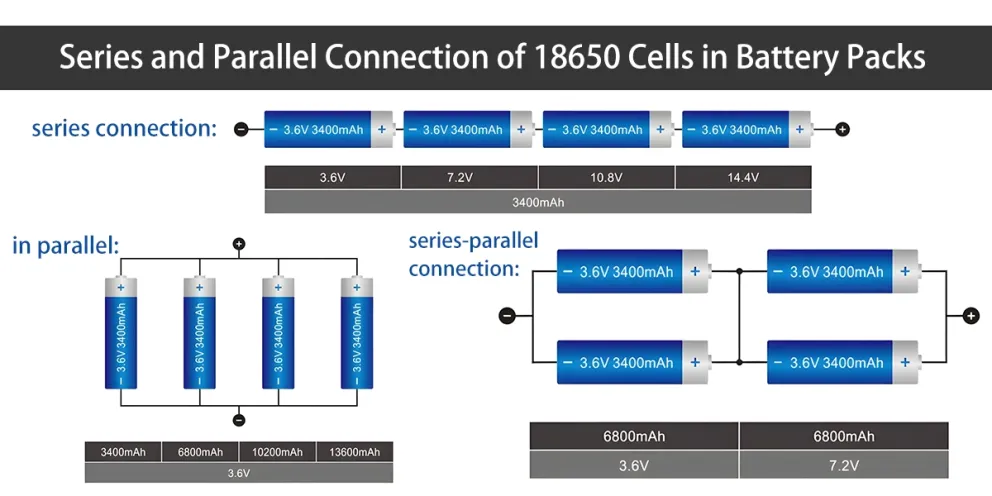
1. Structure and Configuration
Based on your device’s power requirements, we evaluate and confirm the cell layout (like 10S2P or 13S4P).
- Series: Increases voltage to match the rated voltage of the motor or system.
- Parallel: Increases total capacity and continuous current capability to extend the device’s runtime.
As a professional manufacturer, we use 3D Mechanical Design to simulate the spatial layout during the design phase, ensuring the battery pack fits perfectly into your battery compartment.
2. BMS (Battery Management System) Design
The BMS is the “brain” of the battery pack. During customization, we match the most suitable protection board based on your application scenario (e.g., low power consumption or instantaneous high current):
Basic protection: Prevents overcharging, over-discharging, short circuits, and overcurrent.
Smart BMS: Supports communication protocols such as SMBus, I2C, and CANBUS, allowing for real-time monitoring of battery health (SOH) and state of charge (SOC).
3. Thermal Management & Housing
High-power 18650 battery packs generate heat during operation.
Materials: We select PVC heat shrink, plastic casing, or a more robust metal housing based on requirements.
Safety: For demanding robotics applications, we incorporate temperature sensors (NTC) and provide heat dissipation channels in the structure to prevent thermal runaway.
4. Connector and Wire Specification
We select appropriate AWG wire and connectors (such as XT60, Anderson, or aviation plugs) based on the continuous current, ensuring that high current transmission does not cause overheating due to excessive contact resistance.
This is not just assembly, but also solution optimization. Hongyitai engineers will provide optimal balance advice between Original Tier-1 cells and high-quality, cost-effective domestic battery cells, based on your budget and performance indicators. Contact us to start your custom 18650 battery pack today.
Our Engineering Process of Custom 18650 Lithium Battery
Assembling battery cells into high-performance battery packs requires a series of rigorous engineering steps. In our factory, every Custom 18650 battery pack undergoes the following standardized processes to ensure high-consistency delivery:
1. Cell Grading & Consistency Matching
This is the first step in ensuring battery pack lifespan. We don’t just source cells; we perform precise cell grading on each one. Through high-precision grading, we control the internal resistance (IR), voltage (V), and capacity variations to a very low range. Only cells that meet consistency standards proceed to the next process.
2. Automatic Spot Welding
To ensure the stability of high-current transmission, we use automatic spot welding machines for nickel strip connections. Compared to manual welding, automated welding ensures that the pressure and time at each weld point are completely consistent, avoiding excessive contact resistance caused by overheating damage to the cell caps or weak welds. For high-drain applications, we use custom-made thick nickel strips or composite copper-nickel busbars.

3. PCM/BMS Calibration & Testing
After connecting the BMS to the battery pack, we perform functional verification: overcharge, over-discharge, and short circuit tests to ensure the protection circuit triggers accurately. For smart battery packs with communication protocols, we also perform SOC (State of Charge) calibration to ensure accurate displayed power data.
4. Aging Test & Load Simulation
Before leaving the factory, all battery packs must undergo 100% aging testing. At least one complete charge-discharge cycle is performed. By monitoring the temperature rise and voltage curves of the battery pack under peak load, we ensure stable operation in the high-intensity environments of robotics or industrial equipment.
5. Final Quality Audit & Certification
The final step is OQC (Outgoing Quality Control), which includes visual inspection, insulation testing, and UN38.3 packaging verification for international shipping.
How to Select the Right 18650 Battery for Your Application
There is no single best battery, only the solution best suited to the application scenario. Different industrial equipment has vastly different requirements for discharge curves and durability. Below are our selection recommendations as a lithium battery manufacturer for several major industry applications:

Robotics applications typically feature high instantaneous power consumption and frequent start-stop cycles. High-drain continuous discharge capability and excellent thermal stability are essential.
You need to choose an INR chemistry system. To support the surge current during robotic arm grasping or motor startup, we recommend selecting cells with a continuous discharge capability of 15A-20A or higher, such as INR18650-25R or equivalent industrial power cells.
Medical devices (ventilators, portable monitors) have extremely stringent requirements for safety and runtime. This requires extremely high energy density and a long shelf life, and must be IEC62133 certified.
You can choose high-capacity ICR or INR cells (3500mAh). Since medical devices typically operate with stable current, capacity takes precedence over discharge rate. Simultaneously, the BMS must have multiple redundancy protection functions.
3. Industrial Power Tools
These devices operate in harsh environments, frequently facing shocks and high temperatures. This requires low internal resistance to reduce heat generation, and a high cycle life.
You should prioritize reinforced power cells. These cells have thicker steel casings and more sensitive integrated pressure relief valves, effectively handling the physical stress from high-frequency vibrations and rapid charging and discharging.
4. Portable Energy Storage and Sensors
For outdoor monitoring stations or small energy storage devices, this requires consideration of procurement cost and cycle life.
If space permits, consider higher-capacity cells from leading domestic brands. This will allow you to obtain a competitive price while ensuring a high-quality BMS.
If you are unsure which model is best suited for your equipment, please submit a form and our engineering team can provide a Performance simulation report to help you determine the most stable power solution, and let custom lithium battery together.
FAQs About 18650 Battery Pack
These two batteries differ in their chemical composition and performance.
ICR (LiCoO2): High energy density, but relatively low thermal stability; primarily used in portable electronic devices with low current requirements.
INR (LiNiMnCoO2): Also known as NMC cell. It combines the high capacity of nickel with the low resistance of manganese.
Tier 1 (Premium): Samsung, LG, Panasonic/Sanyo, Sony/Murata. These brands offer extremely high consistency in their battery cells.
Tier 2 (Cost-Effective): Leading Chinese brands such as EVE, BAK, and Lishen.
We source directly from the aforementioned original battery cell manufacturers, ensuring reliable battery pack quality from the raw material stage.
If your space allows or you require higher power, you can consider the 21700 and lithium polymer battery.
Leave Your 18650 Battery Pack Message Below: